Showing posts with label Numbers Shapes and Colors. Show all posts

Monday, June 30, 2014

Get your child started with counting!


Ordering the world through numbers is an important skill.  Any time you want to teach something, you have to know exactly what your student already knows. In the case of counting, this is super easy.  

If you have been following along with the at home pre-school boot camp, you established a daily play time with your child last week.  One day during your play time, grab a set of toys such as blocks.  Say, "I've got a question for you,  How my blocks is this?"  Plop down a set of blocks that you know your child can count. It is extremely important that their first attempt is successful, even if they only count to one. Next, ask for an amount that is maybe two blocks more. Repeat until you find an amount that he is  unsure of.   Mark this number in your mind.   

Say, "Watch me."  Very purposefully point to each block and number it out loud.

Next, pretend to place blocks and ask, "How many?" while pointing to the empty space.  Treat this as a joke, but make a mental note of whether he knows the number zero.  

Remember the number he didn't know, and whether he knew zero, and spend at least a few more minutes connecting through play.  

You can repeat this activity about once a week.  Development will tend to go in spurts.  For several weeks it may seem he is not getting any where .  Then, he will suddenly progress by several numbers or beg you to count over and over.  

Watching your own child progress as a learner under his own power is a thrill you will always treasure!


Click here to return to the At Home Pre-School Boot Camp: Week 2 Summary


Tuesday, May 6, 2014

Project Recycle! Create!: Math from Egg Cartons


Egg Cartons suggest math to me.  I think it's all those nice even compartments.  Even before I joined the Recycle!Create! group I had already done a skip counting practice activity from an egg carton.


 My four-year-old daughter absolutely loves it, and even asks for it when it's put away.

Apparently, I am not the only one who thinks math when trying to re-use old egg cartons.   Take a look at these great projects that I found on the Recycle! Create!  Link-up.


Color Sort from Powerful Mothering

Number Exploration by Sparkle and Pook This is an introduction to counting.

Counting Activity from an Egg Carton by There's Just One Mommy This one is to practice counting.

A Ten Frame by Teaching Every Day Would be great as an introduction or review of counting to 10, and I love her detailed explanation all the benefits from this activity!

Mancala from Marie's Pastiche I was going to do this until I came across her post.  I am glad she linked it up because she has a fantastic explanation of the game's background.  You can try this with wee little ones and it challenges adults too!

Tuesday, February 25, 2014

How does playing dominoes count for math class?


One of our school activities this week was dominoes.  Here's how I use it to cover specific math objectives.

First, let's remember that there are math skills built into the game of dominoes.  Understanding the rules of dominoes requires matching and pattern making skills.  Trying to win the game develops analytical and strategic skills which are valuable in mathematical problem solving all the way to the collegiate level.

When my kids were first learning to count, I would point to the animal that was laid down and count how many there were.  When they felt comfortable, they imitated me.

Now that my four-year-old is comfortable counting past six, and interested in addition (benefits of following a sibling!), I point out that there are six bees and six more bees.  "How many is that all together? One, two, three...eleven, twelve!" 

During the course of our game she interupted me.  "No, Mom, let me count."  While I do believe my child to be exceptional, I think most kids will do this naturally if it's modeled on a pleasant way.

My five-year-old has the concept of addition down and needs to work on counting higher numbers.  I thought this would be a good opportunity to introduce multiplication.  "Look, we have four sets of donkeys and each set has four donkeys in it.  How many does that make?  One, two.."  We also used some skip counting.

A key to making this an effective lesson for my children is  that I never require them to count.  I just model happily on every turn.  When they are ready, they copy.  Requiring them to stretch for a new skill would add stress and take away not only the fun, but also the effectiveness of the lesson.

Does just playing dominoes cover a sufficient amount of math?  It depends on what your objective is, and how you play.  For my objectives this week, I believe it did.

What games do you enjoy at math time?


Linked up with other great kid learning posts at 
parents as teachers

Friday, January 17, 2014

Egg Carton Skip Counting with Printables


This activity addresses several different skills.   For kindergarten purposes, it most directly addresses the Common Core objective CCSS.Math.Content.K.CC.B.4 ,  Understand the relationship between numbers and quantities;connect counting to cardinality.   However, it is also preparation for multiplication, and a fine motor exercise.

Tuesday, January 7, 2014

Pre-school developed counting practice

Not only is this activity great fine motor and counting practice, it's a sure winnner with my pre-schooler.  How do I know?  She came up with it!


Monday, January 6, 2014

Skip counting by 2's: A visual kinesthetic activity


I hope you all had a wonderful holiday season!  Ours was full and happy.  Today, we jumped back into school, even though I felt a little under-prepared.  Within the next two months, we are planning to move (again, just a couple of miles this time) and welcome a new family member!  Obviously, I am on the look out for ways to make learning fun and easy for all of us.  Please post in the comments if you have a great resource to share.

One of my friends gave us a copy of Life of Fred Apples,  by Stanley Schimdt which we enjoyed twice, and just before Christmas, Life of Fred Butterflies arrived in the mail.  My kids find the books hilarious, and my son is really motivated to do the exercises at the end, in order to earn the right to progress to the next chapter.  The Schimdt jumps right in with counting by fives in Life of Fred Apples.  Now in Life of Fred Butterflies, he is asking for counting by twos.  This is a second grade  skill according to Common Core, and a little tricky for my five-year-old.  I came up with this exercise to make it more concrete.  


The only materials needed are a measuring tape and a bunch of clothespins.  Before we got started I read, Penguin Pairs:Counting by 2's  by Amanda Doering Tourville which we had borrowed from our local library.  After we finished, I directed my son to begin with two and put a clothes pin on every second number.   He went to work eagerly.  As he worked, I asked, "What's that number?"  If he was not sure, I helped him get the correct name which helps us work toward our kindergarten level objective of being able to name all the numbers up to one hundred. (CCSS.Math.Content.K.CC.A.1).

When he finished, he was so proud he insisted on taking a photo of his own.  


Later, when we came to the related question in Life of Fred, he referred back to his number line.


You may also like this post:        


Tuesday, July 2, 2013

Matchbox Math: Counting to twenty


 My son is really into his matchbox cars right now.  My mother-in-law says my husband was the same way at this age, and she has generously supplied most of his fleet.  We have been using the cars to practice counting, and he actually asks if we can count cars.  To help him understand the symmetry between one through ten and eleven through twenty, I drew this quick parking lot one day last week.  My son has seen plenty of numbered parking spaces so it was an instant hit.


Over the weekend, I finally buckled down and made some roads from old jeans.  I found the project from LilMopTop on Pinterest.  Click here to check it out.  While I was having fun with glow in the dark paint, I decided to make a more permanent parking lot.   It is seeing some heavy use!


 I ask him to say the numbers while looking at the empty parking lot, then add a couple of cars and do it again.   He is showing great progress.  

Next, I am working on putting together a science unit involving matchbox cars.  I'm really excited to practice  with my kids. Hopefully, it will be ready share sometime next week.

Do you have any fun projects that you like to do with matchbox cars?


Tuesday, May 14, 2013

Basic bead counting cards


Inspired by a more beautiful, and more expensive, project found on Pinterest, I made a couple of these to help pass time in the car .  They were never used in the car, but a few days ago my son found them and was interested.  I made some more to put in his bucket in the playroom. 

 These are as simple as they look: beads strung on cheap string which was then poked through index cards and knotted in the back. Using rows of ten reinforces the decimal system, and the crayon number on the back makes it a self-correcting activity.

Today, I told my kids I had something I wanted to show them, pulled out the cards, and let each of them take a turn counting the beads.  I was happy to see that my four-year-old caught on to the fact that the green row should always equal ten.  When he accidentally counted nine, he stopped himself, shook his head and started again. 


Their eyes actually lit up when they saw the number on the back that corresponds to the number of beads on the front.  I  love those moments.

Do you have a good self-correcting activity to share?

Saturday, March 2, 2013

A Realization about Counting

These dominoes were a great Christmas gift !

I love watching my kids develop the basic skills that will some day build into the challenging physics I used to teach.  This morning while we were waiting on Daddy to finish up the pancakes, the kids and I played a round of animal dominoes.  My daughter loves the matching aspect and my son loves that we can make shapes with the path of the dominoes.

Thursday, February 21, 2013

Learning with Playdough

Play dough is an amazing substance.  My kids will play with play dough for hours.  

When we lived in Kuwait, making play dough was by far easier than trying to find it.  A good friend asked me to "try out" a recipe for a church group, and I am grateful for the nudge in the right direction.

Homemade play dough recipe


This recipe comes from CEF:  1 part corn starch, 2 parts baking soda, 1.5 parts water.  (i.e. 1 cup cornstarch, 2 cups baking soda, 1.5 cups water)

1.Mix everything in a sauce pan.
2. Cook and stir on medium low heat, until all at once it comes together and forms into a ball.
3. Cool.
4. Knead in a little extra cornstarch as you go.

I have to admit I was scared to try it, but it turned out brilliantly!  Of course, you can always buy the commercial version.

What do we do in those happy hours?


 Make stuff. 


I've noticed that my kids are interested in making stuff longer if I engage in a little parallel play making stuff too.  This took a little effort at first.  After a while, it became a relaxing opportunity to try something new.  The picture above is my attempt to mimic pottery done by the Cherokee.  Not the work of a master, but it was fun.


Use tools.


When I see that just making stuff is getting a little boring, I like to introduce stuff: the random piece of plastic my son is using above, butter knife, rolling pin, tooth picks, slotted spoon. Of course, sometimes my son starts pulling out tools as soon as we pull out the play dough.

Practice math skills.


My kids love asking me to make tiny balls, which could also be called spheres.  Sometimes we make cubes and build structures.  Sometimes I ask for a particular number of pieces of play dough.  My daughter can count to six pretty easily right now, so I ask for four first.  Then I ask for seven, then five and so on.


Write.


When we were learning the alphabet I made letters and asked for their names.  Then I asked for the sounds that they make.  Now I make simple words and coach my kids to sound them out.  You could do the same with numerals.


Of course, all this time we're strengthening the muscles needed for fine motor skills.  

Using just one activity I cover all my objectives for the day.  Even better, I connect with my children in a way we all enjoy.


Saturday, February 16, 2013

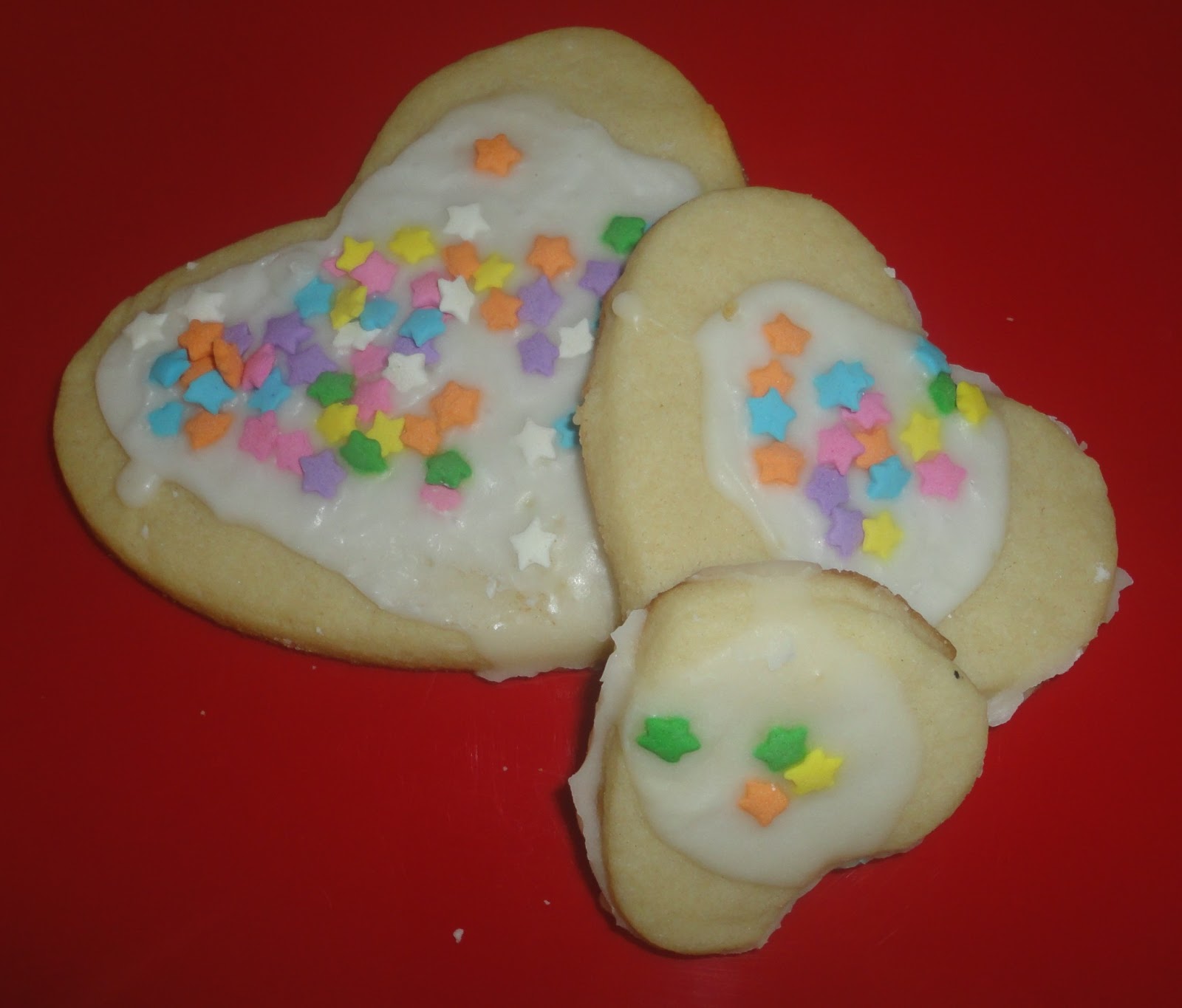
Holiday Cookies


We love making sugar cookies for any holiday, or in between holidays.  I use a recipe from the Mennonite Community Cookbook, edited by Mary Emma Showalter.   Few ingredients, no chilling, and perfect texture ever time make this one more treasure from my Mennonite friends.  

My kids love to do the measuring and mixing.  I place the flour and the measuring cup on an old (see it doesn't look good!) cookie sheet to conserve any spillage while my daughter spoons the flour into the measuring cup, Then we work together to level it with a knife, and count out the number of cups needed.  Perfect toddler math lesson and motor skill practice!


The reason I love this recipe is that as soon as the dough is mixed, it's ready to roll.  I clean a section of the table and use the spilled flour from the cookie sheet to flour it and the rolling pin.


This week we used different sized hearts.  She really wanted to use them all every time, so I explained that the best strategy was to work biggest to smallest.


After the cookies were baked and cooled I mixed a little milk with powdered sugar and added some sprinkles.  (Hint: Mix in just a little milk at a time, and your frosting won't be runny like mine.)


  This recipe was submitted by Mrs. Simon Gingerich.


Ingredients
1 1/2 cups butter
1 1/2 cups sugar
2 eggs
4 cups flour

I like to add 1 teaspoon of salt and 1 teaspoon of vanilla with the wet ingredients to give a little flavor.  


Pre-heat oven to 375 degrees F.  (190 C). Mix the wet ingredients well, then add the flour little by little. Roll out to about 1/8 inch (0.5 cm) thickness and cut with cookie cutters.  Bake until done, about 10 minutes.

Baking with kids is a great way for them to learn.  It's also a great way to stress myself out.  I always allow at least four times the time it would take me to accomplish the task by myself, and don't expect to multi-task.  I keep the ingredients on the counter, and give my kids exactly what I want them to have at that moment.  I expect them to entirely need to change clothes when we're done, and I banish them from the kitchen while I finish baking and clean up.  So far, they're always eager to join in when it's time to bake.


You might also like:
Add a little Biology to your Baking


Friday, January 11, 2013

Jamaican Time Rhyme


When Johnny was one, he learn to suck he thumb,
Thumb Tilda, thumb Tilda, half past one.

When Johnny was two, he learn to clean he shoe,
Shoes Tilda, shoes Tilda, half past two.

When Johnny was three, he learn to climb mango tree,
Tree Tilda, tree Tilda, half past three.

When Johnny was four, he learn to shut de door,
Door Tilda, door Tilda, half past four.

When Johnny was five, he learn to dig an' dive,
Dive Tilda, dive Tilda, half past five,

When Johnny was six, he learn to pick up sticks,
Sticks Tilda, sticks Tilda, half past six.

When Johnny was seven, he fly up to heaven,
Heaven Tilda, heaven Tilda, half past seven.

When Johnny was eight, he learn to shut de gate,
Gate Tilda, gate Tilda, half past eight.

When Johnny was nine, he learn to feed de swine,
Swine Tilda, swine Tilda, half past nine.

When Johnny was ten, he learn to feed de hen, 
Hen Tilda, hen Tilda half past ten.

Jamaica

This mesmerizing little piece comes from A Caribean Counting Book by Faustin Charles and Robertan Arenson.  We've done it two ways, and enjoyed them both thoroughly.

Simple Counting


When we first came accross this poem, my two-year-old daughter was just learning the basics of counting.  As I read the rhyme, I illustrated it by holding up my fingers, starting with my thumb, and dancing them in the are to the rhythm of the syllables.  She was soon holding up her little fingers, connecting the number names with the concepts they represent through tactile means.

The inability to do math without fingers is sometimes lamented in older elementary children.  However, as a former physics teacher, I'm much more disturbed by high school students who cannnot do math on their fingers.  There's nothing wrong with counting on your fingers until you're proficient enough that it's inefficient anyway.  Well, that's my opinion.

Telling time


My four-year-old son was already fairly comfortable with counting.   I try to make a point of having a an old fashioned clock with hands in the house when I can, and he had become interested in the clock on our wall six months or so before.  I taught him that when the longer hand was on the twelve he could look at the shorter hand to tell "the o'clock".  He'd watch the clock, just waiting for a chance to tell us what time it was with accuarcy.

This rhyme presented the perfect opportunity to add to his time-telling prowess.  I pulled out our trusty Melissa and Doug clock puzzle. We reviewed how to know when it was an "o'clock time, reviewing an establised skill before moving to the new one.  Then I moved the long hand to the six, and announced that this was the half-past position.  I then asked him to place the small hand on the one.  As we progressed through the poem, he eagerly moved the hour hand around the face of the clock.


Rhyming


As I read through the rhyme, I stop before the number allowing my children to fill in the number that rhymes with the preceding rhyme.  "Shoes Tilda, shoes Tilda, half past ____."  They enjoy filling in the "two" that rhymes with shoe, and sharpen the phonological awareness that reading experts say is so important.

The rhyme ends with ten, but the clock does not.  My son agrees with the clock, so we keep going and my children to generate the needed tasks for Johnny that rhyme with eleven and twelve.  

I hope you enjoy as much as we do!


Saturday, January 5, 2013

Thursday, December 27, 2012

Jamaican Centipede Rhyme


My kids and I enjoyed the book so much the first couple of times through, that I thought we could get more use out of some of the rhymes.  To help  us get the most out each rhyme, I started making up visuals.  

Friday, November 2, 2012

The Change Game:Level 1

Our family is currently residing in a hotel.  Every week or so I go to the desk ask for alot of quarters and ones.  Quarters for the laundry, ones for the nice lady who cleans for us.  My kids are fascinated by the coins and just love to handle change. So I made a simple game for them.


Book of Thanks


I was really happy with the results of our Thanksgiving calendar last year.  However, this year we'll be living in three or more different locations during the month of November.  Since our hotel rooms are not conducive to hanging butcher paper on the wall, I needed an alternative.  

Monday, October 22, 2012

School Sparks Worksheets

One day I was seraching for a quick activity to entertain my three-year-old, and I happened into the gold mine that is SchoolSparks.com.  On this site retired pre-school teacher, Renee Abramovitz shares insights that she's gained in an entire career of teaching little ones.  She gives a thorough explanation of the knowledge and skills that constitute kindergarten readiness.  As a former secondary teacher turned current mom of pre-schoolers, I was thrilled to have this information outlined so clearly.

  In addition, she provides worksheets for free!  Both of my kids (ages 2 and 4 now) will sit and do work sheet after worksheet.  The only draw back is that printing the lovely color sheets can get pricey.  My brilliant husband, seeing how much the kids were enjoying the worksheets,  suggested that we laminate the sheets so that could they could be done with dry-earase marker or grease pencil, then used again another day.  I was all set to go to the office store to print out a number of worksheets when, Mrs. Abramovitz  put out her new book, 461 worksheets for only $28, and tons of advice for parents along the way.  It's fantastic deal.  I ordered our copy almost immediately and picked up a personal laminater from Wal-mart.  The laminator was the pricey part of the project, but I definitely think the expenditure was worth it.  The evening we laminated, the kids were grabbing the sheets out of the machine.

Here's how we've used School Sparks book of worksheets so far.


 Fine Motor and Counting.


  I knew we wanted to work on writing/fine motor, so I pulled out all the fine motor worksheets, and we laminated them.   My four-year-old will do all the fine motor practice pages in one sitting, and sometimes repeat several before he begins to lose interest.  My two-year-old will do the first three or four.  I love that they can practice over and over, and they think they're just having fun. We also did the counting counting sheets.  My two-year-old works on the first page, while my four year-old works on the more advanced pages.  We only pull these out every few weeks, so it's an exciting new way to count every time.

Reading Skills. 

 The worksheets are printed on good sturdy paper.  However, not even card board would stand up to my little boy's strong hands.  So, we laminated the reading tools as well.  We just started the Dolch sight words, following Mrs. Abramovitz's method, and so far he's doing well.  We also played around with the word makers, and I can tell we'll enjoy those as well. 

I had never realized that rhyming was an important pre-reading step.  We pulled out the rhyming cards this weekend, and there was alot of complaining about putting them away.  We're having a little trouble with it though, so I want to get some books from the library to supplement before we try again.


A nice little side feature of the word makers.  The pictures on the card match the pictures on the strip.  This is a great pre-school organizer, and actually serves as an activity in itself for my toddler.


And there's more!  

Here is our book minus all the hours' worth of materials above. Since some of the worksheets work just as well as parent-child activities, I'm leaving them in the book for now.  The worksheets are graded, meaning you should start with the first, and work progressively in order.  I put an index card with each child's name in each section of the book to mark our place.  Every so often, we'll sit down and work through a page or two.  I find that using the worksheets in this way not only provides instruction for my child, but it's a handy assessment tool to help me know what areas I should be addressing at other times.


Thank you, Thank you! to Renee Abramovitz and her team for providing such a wonderful resource at such a low cost.  As a mother of pre-school children, I will always be grateful.