Showing posts with label Science. Show all posts

Friday, August 1, 2014

Shadows: How a baby can learn science along the way


Little Diddle (5 months) went with me to take some excess garden produce to the neighbor.  On the way home, she noticed something interesting.  She leaned forward and made little cooing sounds to alert me to her discovery.

Can you believe it?!  The sun's rays were bouncing off the road.  However, none of the rays could travel straight through our bodies.  Only the rays that refracted (bent) around our bodies could make it to the piece of road we blocked from the sun. The result was a dark spot shaped like us that traveled just in front of us.  


I love that idea.  One way to do facilitate that learning is by simple time outdoors. By celebrating these simple discoveries with our kids, we encourage their science learning.  

What has a little one next to you seen recently?


The purpose of this  Science Along the Way series is to remind me, my children, and my readers to celebrate the wonder of the natural world around us.  Scientific statements on this blog are made with the intention accuracy.  If you see an error, kindly leave a correction in the comments.

The post, Shadows: How a Baby Can Learn Science first appeared on WisdomKnowledgeJoy@blogspot.com.

Saturday, July 26, 2014

The Other Way to Make Balloons Float


"Hey Mom, Look!"  Have I mentioned that is my favorite phrase?  Well, at least when it means "Look what I noticed," not "Watch me break my leg."

These balloons were filled with plain old air, not helium.  However, they were floating up, and then falling down again in a kind of circular pattern.  It was really quite mesmerizing.  When I asked my children why this was happening, they quickly identified that the air particles from the vent were hitting the balloon and making it move.  This is great, because understanding that air is made of molecules that can have this impact is one way to prove that gas can have mass, and therefore really is matter.  Most people today readily believe this, but it is not actually all that intuitive, and has been highly debated in other times.

T-Rex was able to give me a clear explanation of the major forces.  Gravity pulls the balloons down, the air molecules push them up.  When the force of the air molecules is greater than gravity, the balloon moves up.  When the force of the air molecules is smaller than the force of gravity, the balloons move down.

In terms of energy, there is a transfer of kinetic (moving) energy from the air molecules to the balloon. As the balloon moves up it trades its kinetic energy for potential energy due to gravity.  When it falls toward earth again it trades the potential energy for kinetic energy once again.  

Next time you notice a moving object, stop and ask.  Why is it moving? It can be a pretty interesting question.


The purpose of this Science Along the Way series is to help me, my children, and my readers stop and notice the amazing physical world in which we live every day.  Thanks for reading!


This post "The Other Way to Make Balloons Float, by Christy McGuire, first appeared on WisdomKnowledgeJoy.


Friday, July 18, 2014

Pivot Points and Spinning Spoons


Children are hard wired to do science.  T-Rex (5) and Pony Artist (4) demonstrated this the other day at breakfast.   I do not know who started it, but they took turns spinning this spoon.


They discovered that the spoon spins best when just one point touches the table.

  They tried placing the spoon with both ends touching the table. It did not spin well, and tended to flip over.  

It was a perfect experiment with just one variable: which way the spoon was facing. I pointed out to them what they had done, but they were more excited about the spinning spoon itself.


You see, they had just figured out an important physical principle.  Solid objects naturaly spin around a single point.  They might not put it into words just yet, but they definitely learned it. 


What have you and yours learned from play this week?

Saturday, July 12, 2014

Amazing Whistling Eggs!


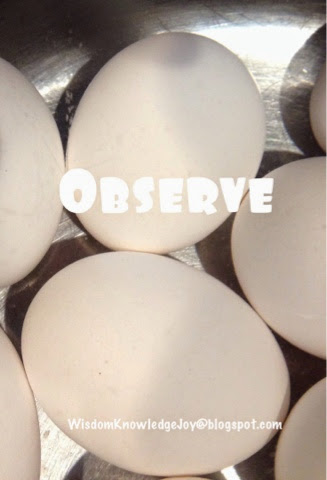
  Deviled eggs are great for potlucks, sliced eggs add protein to summer salads, and all that egg boiling provides an opportunity for some interesting observation.

Boiling eggs are noisy!  Shrill whistling sounds accompanied the cooking process in this photo, and you can see why.


  Those little bubbles were escaping from all the eggs.  The Pony Artist was very interested in the little bubbles.  I told her that I thought they were made of air that was expanding inside of the egg.  She was fascinated to learn that there can be air inside of an egg.  I explained that the shell allows air to pass through it, providing oxygen to the chick inside.  At this point, she became very concerned that we were preparing to eat baby chicks.  I assured her that this was not the case.  Eggs containing chicks do not make their way to grocery stores, and are not generally eaten --at least not in our culture.

While we were on the subject of cooking eggs, I explained that it is important to turn up the temperature on the water slowly when cooking eggs.  Causing the expansion to happen to quickly will break the shell.  I also demonstrated that phenomena this week, but did not photograph the ugly results.

 Finding all three states of matter, , gas, and a solid composing a single object is fascinating to me.

Has anything fascinating appeared in your kitchen recently?


The purpose of this Science Along the Way series is to help me, my kids, and my readers appreciate the wonder of the natural world in our every day experience. If you have an experience that you would like to share, please e-mail me at WisdomKnowledgeJoy@gmail.com. 

The Post "Amazing Whistling Eggs!" first appeared on WisdomKnowledgeJoy@blogspot.com.

Saturday, July 5, 2014

Bottle Rocket Experiments

This activity addresses Next Generation Science Standard
5-PS1-4.Conduct an investigation to determine whether the mixing of two or more substances results in new substances.

When I first started with the Recycle! Create! group, I thought that I was challenging myself to develop activities for my children.  However, it has become very obvious that my older children, T-Rex in particular, are beyond that.  They still need guidance and supervision , but they can do their own projects.

So, if you will indulge some Mommy bragging, I would like to show you their bottle project.

T-Rex wanted to use vinegar and baking soda to launch a bottle.  Pony artist wanted to try it too, so they each carefully measured baking soda and vinegar and recorded the amounts in their journals.


I prompted them to mix their ingredients at the last minute and we set up our rockets out doors.


We were not thrilled with the results, so we went in and journaled.  It was time for me to take care of Little Diddle, so they did not get to try again that day. 


 Our basic problem was too much baking soda.  I pointed this out, so the next time they had time to work, T-Rex adjusted the amount.  It was perfect!  It reacted quickly and explosively!  All over me, so no pictures.

The next step will be to figure out a mechanism that allows us to get things set up before the explosion.  We have done some work on it, but no success yet.  I will let you know if we figure it out. If you have an idea, we would be interested to hear it.


Do you have your own ways to use bottles?  Join the Link up!


Friday, July 4, 2014

Camouflage in the House


  Can you see what the Pony Artist found?  The little grasshopper blended quite nicely with the goo.  (Old weatherstripping, I think.  There is always one more project, eh?)


When we disturbed him, he was much more visible against the dark wood.  We eventually convinced our little friend to head outside.

 I always thought camouflage was kind of happenstance, but it seems like the grasshopper knew where he needed to be.  If you know how he knew where to be, we would love to learn more. Please tell us!


The purpose of this series is to help me, my kids, and my readers appreciate the wonder of the natural world in our every day experience. If you have an experience that you would like to share, please e-mail me at WisdomKnowledgeJoy@gmail.com.


Tuesday, July 1, 2014

Passing Down a Way of Life with a Simple Garden Journal--and a The Ultimate Nature Study Linkup!

This activity can be used to address the following Next Generation Science Standards 
K-ESS2-1.Use and share observations of local weather conditions to describe patterns over time
K-ESS2-2.Construct an argument supported by evidence for how plants and animals (including humans) can change the environment to meet their needs.

We had one next door neighbor when I was a girl.  Miss Evie was already somewhere in her seventies when we moved into our new home in the late nineteen eighties.  I was exactly seven.  She lived in the same home where she had grown up, where she had lived as a young married woman, and cared for her husband and parents as each had left this world.  

I used to get her mail on warm summer afternoons in hopes of being invited into the immaculate 1950's era kitchen she cooled by a cunning system of opening windows in the morning then shutting both windows and curtains as the day wore on.  I would sit bare foot on the red company chair by the door, and we would discuss the health of our cats and the progress of our gardens.  She would tell me stories handed down from her relatives who had lived through the Civil War or of her own experience living through the Great Depression.  Our whole family loved her dearly, and I think that in some ways we filled a spot her own children and grandchildren would have held, if she had had any.  That might be one reason she gave it to my dad.  She might have given it to him because of his love for growing things.

It was an old fashioned notebook filled with careful notes in a squarish antique hand.  Miss Evie's father had kept careful notes about his little farm for years.  He recorded where, when, and what grew , and how he tended it.  For my dad, who was now tending plants in the same location, it was treasury of helpful information.

This spring was our in our new home.  I wanted my children to keep journals based on our yard and garden, but was struggling to get them started.  Then I realized, they were not the ones who needed to keep a journal.  I was.   I grabbed a notebook and started filling it with notes .  I measured some plants, counted blossoms, and wrote down some temperatures and rainfalls.  Soon my kids were eager to join me, and they ask if we can do our. "Garden journal".

Our little journal is not all that amazing, or even organized.  It is a start though.  I hope my kids are learning the importance of paying attention to the natural world around them.   Not just as a fun summer project, but as a way of life. The systematic careful attention to how and why things grow that Miss Evie's dad practiced is a tradition I want to pass on to them.


Today, I am joining some other bloggers in hosting a Nature Observation blog hop.
Take a moment to look at the great ideas from my co-hosts!  As you look through the posts, I hope you can find a few methods that allow you to bring the richness of natural observation into your experience, and that of your children. 

July 2 update.  Now that I've had a chance to look at everyone's post, I'm even a bit more excited.  Check these out!


Suzy Homeschooler This is a must read, especially for those of you who are facing extreme weather like we experienced in the Middle East and in Arizona.

Homeschool Antics A great tutorial on how to turn backyard observation into a full fledged  nature study.

Houseful of Chaos  A lovely reflective approach, with a couple of interesting twists.


Study-at-Home Mama If studying nature is a little overwhelming to you, this post has the practical ideas you need.

Inspiring NH Kids Is showing us a great demonstration of a weather phenomenon we often, face.  I will be coming back to this!


My Blessings Homeschool Ideas for creek exploration.  My kids are going to enjoy this one!

Kid World Citizen A great list of fun hands on ideas.


There's also a multi- topic link-up.   I am looking forward to reading ideas you have for observing nature!


Saturday, June 28, 2014

Coquinas: Beautiful Diggers


Sunset over the Gulf of Mexico last week was beautiful.  The beach was re-nourished this year, so it is not quite as pretty, but it is still alive!

We had a great time just watching these little guys bury themselves in the sand. Daddy is the local, so he explained what we were seeing.


Coquinas are a type of clam that live right on the edge of ocean where the tide comes and goes. The water uncovers them as it recedes, and they bury themselves until the next wave brings them their next meal, and in turn retreats.

The shells are beautiful, and even as an adult I could watch them burrow all day.   It is amazing that these little creatures move so fast! I found a picture that shows how they use a muscular foot to bury themselves. Click here and scroll down to the "foot" heading to see it.

The Gulf was in the news a few years ago because of an environmental disaster. A question on many people's mind is how to teach others to respect the lives of creatures like the Coquina. I think that observing first hand is a key part of the answer.

What has fascinated your family this summer?


Wednesday, June 18, 2014

Submarines and Pitch Training with Bubble Wrap

The activity in this post was used with pre-schoolers, but could be used to address this Next Generation Science Standards Objective.

1-PS4-1.Plan and conduct investigations to provide evidence that vibrating materials can make sound and that sound can make materials vibrate. 


This month's challenge from Project Recycle and Create was a tough one for me.  I finally just gave up and put the box of bubble wrap Daddy had collected at work in the middle of the room.   For a couple of days it looked like our bubble wrap project would consist of pinching it with our fingers.  Not creative, but we can always use a little more fine motor practice, right?


Then T- Rex started using a craft stick as a tool and suggested that we could make a submarine, since it would not float as well after the bubbles popped. Clever, yes?


Then the Pony Artist said, "Hey Mommy, listen to this!"  And started happily snapping some bubbles.  As I listened, I realized that the bubbles had a different pitch than the ones T-Rex was popping.  


I invited her to come over to the piano, and we worked on popping bubbles of different sizes and matching them to pitch of the piano keys.  Bigger bubbles make lower sounds. Smaller bubbles make higher sounds. 


 Pony Artist figured it out, but she and T-Rex most enjoyed the rhythm aspect of this activity and treated Baby Sister and I to a concert.

Following my children's lead can take me some pretty fun places!

Click here to go to the landing page for this project and see the host projects.


Have your own Buble Wrap idea or experience? Link up! 


Tuesday, June 10, 2014

Swinging Baby Catch and Inertia


We have a new favorite game.  Baby catch!  Baby sister sits in her swing and T -Rex and the Pony Artist push her back and forth to each other.  It is so sweet!

I asked T -Rex to tell me what force pulls the swing back down.  He knew it is gravity.  Then I asked, "Why does the swing keep going at the bottom of its path, and start moving up?" He was puzzled.

I told him that it is because the swing is already moving. If something is moving, it will keep moving until something stops it. He smiled. 

I asked him again just now if he knew why the swing keeps going.  He answered , "Because it was already moving." Yay!

  Newton's First Force Law says that a thing will keep moving at the same speed and in the same direction, unless something stops it.  This tendency to keep doing the same is called inertia.

Centrifugal (center fleeing) motion is sometimes credited to a force with the same name.  You are not likely to see such a force, and if you did, it would have another name.  The movement away from center is due to inertia.

 The vast majority of circular systems  depend on a centripetal (center seeking) force, in this case the rope, and inertia. 

Here is a challenge for you.  Find some circular motion examples and figure out what the centripetal (center seeking ) force is.

I would Love to hear what you find!


The goal of this Science Along the Way series to help me, my kids, and my readers take notice of the wonder around us every day in the physical world. If you would like to share a phenomenon you have noticed, e-mail me at WisdomKnowledgeJoy@gmail.com.

The post, Swinging Baby Catch and Inertia, first appeared on WisdomKnowledgeJoy@blogspot. com.

Saturday, June 7, 2014

Thunder and Lightning must be Friends


We have been enjoying alot of weather here in the south east US this week.  We were just ready to leave the library on Thursday when the wind picked up and the lights went out.  We spent an hour getting to know some new friends better in the dark while we waited for things to calm down.  

Tonight, things were rumbling again.  As I was tucking him in, T-Rex asked, "So Mom, what is thunder anyway?"   I told him that thunder is energy.  The energy moves through the air, making waves and causing them to rumble.  Our ears receive that chaos as the sound "thunder."

  Energy is the most basic thing in the natural world.   So, I push myself to explain things to my children in terms of energy.  (This is actually debatable, but enough people with Phd.'s agree with me that I am going to go ahead and just make it a statement.) If you want to go a little deeper, you might think about the fact that lightening happens because electrons build up in the clouds during storms.  When the charge gets strong enough, the electrons jump to the ground. This jump releases a huge amount of energy.  Some of it is light, or "lightning".  Some of the energy physically moves out through the air.  That is thunder.

A little later, Pony Artist was out of bed, (That happens on stormy nights, right?)  As she headed back to her room, she turned to me and said, "I think thunder and lightening must be friends."

  All children are natural scientists.  What have yours been observing lately?

Friday, May 30, 2014

Seeing heat: Science along the way


The other night we were cooking out when my son noticed that the air above the grill "looked like water."  You may have seen the same phenomenon on the road on a hot day.  Why can we see heat waves?

Why can we see anything?  


When electromagnetic (EM for short) rays bounce into objects, some are absorbed and others are reflected, depending on their wavelength. (You could say also say frequency, its inverse.)   Rays with wave lengths between 380 nanometers and 750 nanometers in length are received by our eyes and interpreted as colors. 

 If an eye receives all the possible frequencies equally from an object, the brain interprets the color as white. If the eye receives no electromagnetic waves between 380 nanometers and 750 nanometers from an object, the brain perceives the object as black.  So, on the above picture, we can see EM rays of around 530 nm , reflected from the green tree.

The EM waves we usually see come to us through air that is moving pretty slow, at least compared to EM waves which travel at 3 x 10^8  m/s in a vacuum where nothing is in their way.  As the air molecules gain heat energy, they start to move faster.  In fact, an air molecule may be moving so fast that it carries a little piece of the light wave with it as it moves up.  Think of an elevator for light. Our eyes perceive that light wave at a slightly higher spot than where it originated.

The next piece of the light wave may not catch an air molecule "elevator" and put eye perceives it at the original place.  These back to back changes in perception are what make the "watery effect".

So why does water look that way?


Molecules of (liquid) water move much more slowly than air molecules.  Why does it produce the same effect? Hint: The light changes as well.

Take the weekend to ponder.  I will keep an eye on the comments, so feel free to ask for more hints.  I will post the solution on Monday.

This post by Christy McGuire first appeared on WisdomKnowledgeJoy.

Other Posts you might enjoy:

Saturday, May 24, 2014

What is fog?Science Along the Way

This is the first time we have experienced multiple seasons in a temperate climate in quite a while. It has been fun to watch my children react and enjoy.


This is our front yard Monday morning.  My son wanted to know what that stuff was.  After I informed him that it was fog, he said, "Can I go see what it is like?"  After some observation, he described it as "damp" and "pretty cool".

Both descriptions are accurate.  Fog is a collection of water droplets hanging in the air.

Where did the water come from?

In this case, the water had been there for a couple of days.  Warm air is able to incorporate more water droplets in its mix than cool air.  As long as the sun was heating the earth, the water remained as vapor in the atmosphere.  After dark, the molecules in the air began to loose energy, until it was "pretty cool." When the water molecules loose energy, they may decrease in temperature. They may also change into liquid droplets.  

Why do the droplets float?

Archimedes"s principle: if the mass of the fluid displaced by the object is greater than the mass of the object, it floats. (Remember the Greek guy yelling Eureka?)  The force of the fluid on the droplets is called the buoyant force. So, as long as a water droplet displaces a mass of air greater than it's own mass, it floats.  

When a group of those droplets hang in the air, we call it a cloud.  A cloud near the ground is called fog.  When the droplets join together, they bond tightly displacing less air for the same amount of mass.  The force of gravity pulls them to earth, and we call it rain.

The purpose of this series is to help me, my children, and my readers appreciate the natural world.  If you have found science along your way, I would love for you to share it here. 
E-mail me at WisdomKnowledgeJoy@gmail.com for more information.

 Other posts you might enjoy: Cold Blooded Animals on a Cool Day


Friday, May 16, 2014

Cold Blooded Animals on a Cool Day


"Mom, I found a worm and a slug, and they are moving really slow."

We are having what the locals call "blueberry winter".  By "winter", we mean that you will want a jacket in the morning.  However, it is cool enough to slow down cold blooded animals, and I think that was the problem for the little mollusk (slug) and annelid (earth worm) that T-Rex found.

Other classes of animals such as mammals and birds have mechanisms to control temperature.  Their metabolism speeds and their pores close. Our cold blooded little friends loose their energy to the cool air, and that is why they were moving kind of slow.


Here's a nice article on Annelids and 
Molusks I found while doubling checking my facts:
http://www.tulane.edu/~bfleury/diversity/labguide/mollannel.html

The purpose of this series is to help me, my children, and my readers appreciate the natural world.  If you have found science along your way, I would love for you to share it here. 
E-mail me at WisdomKnowledgeJoy@gmail.com.


Thursday, May 15, 2014

Pretend Elevators with Bottle Cap Pulleys

This activity can be used to address the following Next Generation Science Standards
K-2-ETS1-1.Ask questions, make observations, and gather information about a situation people want to change to define a simple problem that can be solved through the development of a new or improved object or tool.
K-2-ETS1-2.Develop a simple sketch, drawing, or physical model to illustrate how the shape of an object helps it function as needed to solve a given problem.
K-2-ETS1-3.Analyze data from tests of two objects designed to solve the same problem to compare the strengths and weaknesses of how each performs.
Project Recycle! and Create! has provided me with some much needed motivation to do creative projects with my kids this year.  This month's challenge is to make an activity with or for our kids using bottle caps.

We made play animal elevators with operational pulleys.


 My children helped engineer their elevators and enjoyed using them for pretend play when we finished.  It was a fun introduction to a simple machine.

Materials: bottle caps, preferably of a few different sizes
A Box
String 
Glue
Clothes pins
Small play animals

I let my children choose where to place the initial bottle caps, then hot glued them in place.


I tied string to some clothes pins.  They attached the animals.  My daughter put her favorite little turtle in a car made from a candy box.


I originally envisioned a multiple point pulley system, but they were intrigued lifting their animals with just one.  


My son was frustrated that the string kept slipping off of the pulley.  We solved the problem by gluing a larger lid on the outside of the pulley.


This kind of physical play is great for developing an intuitive understanding of physical properties. We also worked in a little problem solving.  I would like to come back to this concept and add some complexity when they are ready.  For today,  they naturaly made it into pretend play, while I slipped off to get dinner.

Lids have provided us with a few other great solutions. Including:

A drain stop  done by the Pony Artist

A lesson in Circular Motion at the Breakfast Table initiated by T-Rex


Check out these projects from my co-hosts.


Or do you have a great bottle cap/lid project?  Link it up!


Sunday, May 11, 2014

Analyzing Informational Texts and Teaching Critical Thinking


My son, like many little boys, is intensely interested in dinosaurs.  We often bring home dinosaur books from the library. This week, we brought home a book that had some glaring errors. It was a great opportunity to teach my children, ages four and five, about thinking critically.

As we opened the book, I pointed out the copyright date:1994.  That was twenty years ago!  A lot can change in in twenty years.  As we read through the book we found several facts that have changed. For example, Tyrannosaurus Rex is no longer the largest known carnivore.   

  Science, by nature, is always changing.  Anytime you research a scientific topic, it is important to make sure you are working with the latest possible information.  Realistically, kids books will never be sources of cutting edge information.  However, we can make an effort to note whether the information they contain is generally current.

 The book we were reading used the terms "ever" and "never" repeatedly.  I took this opportunity to show my children the danger of universal statements.  If the author had simply said, "large" instead of "largest" her work would still be relevant. T-Rex was big, even if it was not the "biggest carnivore ever." 

More importantly, we can not know everything that ever happened, nor observe everywhere.  Any time an author claims to be omniscient, we should be a little suspicious.

When we come across errors in our reading material, it is tempting just to substitute what I believe to be the correct information and move on. This was a start in teaching my children to analyze their reading material.  Hopefully, they will develop healthy thinking habits in the years to come.

What other types of fallacy do you think are important to note in informational texts?


Other Posts you may find useful:

Must Read Science Book :  A Review of Boy Were We Wrong About Dinosaurs

First Lessons

If you found this post helpful, I'd love for you to add this blog to your reader!


Friday, May 9, 2014

Science Along the Way: Why Does Tapping a Jar Lid Help it Open? And an Invitation for Guest Posts


Why does tapping a jar lid make it open more easily?

This question comes from Summer at Outside Kid and her kids.  It would take some more involved experimenting than I can do to be sure, but here's my best guess.  Thanks to my husband for helping me with this answer.  

First, let's think about what forces are working against you as you unscrew the lid.  Friction is the force between two surfaces that opposes motion between surfaces.  The magnitude of the friction is dependent both on the types of materials involved, and the surface area in contact between the surfaces.

 The other important force is the one created by the low pressure inside the jar.  The manufacturer intentionally removes air from the jar so that more particles push on the lid from the top than  from the bottom.  The lid is pinned to the jar by the weight of the air molecules pushing down on it.

Now, back to the knife tap.  The knife tap bends the lid just a little bit.  This decreases the surface area in contact with the jar, and may let in some air.  The decreased surface area leads to a decrease in the magnitude of the friction.  Any air that comes into the jar, helps push the lid up.  For more on why air would flow into the jar, read about playing with a straw here.

Thank you, Summer, for this great question!  I am always amazed at how complicated every day physical events really are.  Summer's family has been busy building the coolest tree house ever!  You might want to click over and take a peek.


The goal of this Science Along the Way Series is to help me, my kids, and my readers appreciate the wonder of the physical world that surrounds us every day. If you find an phenomena worth pondering along your way, I would love to feature it as part of this series. Guest posts and questions are welcome.  E-mail me at WisdomKnowledgeJoy@gmail.com.

Sunday, May 4, 2014

Project Recycle! Create!: Egg Carton Boats

This activity can be used to address the following Next Generation Science Standards
K-2-ETS1-1.Ask questions, make observations, and gather information about a situation people want to change to define a simple problem that can be solved through the development of a new or improved object or tool.
K-2-ETS1-2.Develop a simple sketch, drawing, or physical model to illustrate how the shape of an object helps it function as needed to solve a given problem.
K-2-ETS1-3.Analyze data from tests of two objects designed to solve the same problem to compare the strengths and weaknesses of how each performs.


April's challenge from Recycle! Create! is to use egg cartons to do a project with or for your children.   

Unfortunately, for the environment, eggs only come in Styrofoam in our area.  I decided to ask my children to make boats from the egg cartons.


It took a couple of weeks, but last weekend we finally got the perfect day at the park.  After a family bike ride/walk  we finished off our morning at the cool stream. They even got to do some wading.  


A few things I think they may have learned through this project: school glue does not hold up in water. Tying your string to the boat works better.  Water currents follow the same pattern on their way down the stream. There are tadpoles in our local stream.  

For more great egg carton ideas check out these from my co- hosts.

Volcanoes from Still Playing School
Fairy Houses from P is for Pre-schooler
Easter Cross from Teach Me Mommy
Sculptures from There's just One Mommy
Building with Mud from Planet Smarty Pants
Rainbow Garden Mobile from Lemon Lime Adventures
 Teenage Mutant Ninja Turtle Play Figures  from Sugar Aunts


If you have an egg carton project of your own there is still time to linkup.  Click here to go to the link up.