Showing posts with label Life Skills. Show all posts

Tuesday, June 10, 2014

How to Plan a Road Trip your Kids will Love: Tip 3


Kids love routine in every context.  I knew we had really gotten comfortable with our traveling routine the night that we walked into our hotel room, and my three-year-old headed straight for the bathroom, undressed, and hopped in the tub.  Here are a few hints on how to establish a routine while on the move.

Pack by activity

Since  our children are too young to take responsibility for their things, my husband suggested this system. It works so well!

We have one overnight bag with all of our toiletries and pajamas.  We pack clothes by outfit in Ziploc storage bags, in the suitcases.  Each evening, when we pull over to sleep, we each choose one outfit for the next day and put it in the toiletry bag.  The overnight bag and electronics bag are the only ones that need to come in, unless we also grab the swim bag!  Giving the children control of what they wear and eat helps them feel more settled in the craziness of traveling. 

In the morning, dirty clothes go back in the clothing bag. The laundry bags stay in the vehicle unless we are washing the laundry.  Then it is taken to the laundry room, and everything repacked in the ziploc bags. Each child has their suitcase with just a jacket, stuffed animal, favorite book.  Well, occasionally other items mysteriously appear.  All electronics go in one bag, though.  That makes it easy to be sure everything is charged over night, out of the heat and not luring thieves to break our windows. We also have a bag just for car activities, a bag for food that I can reach, and often a second store of food and water in the back.  This system saves my husband and I stress, allowing everyone to have a better time. 


Rest Stop Routine

Whenever we pull over, every one is mandated to use the toilet.  Then, we spend a few minutes exploring or playing tag.  Either my husband or I quickly discards trash and organizes snack, drinks, and activities so we will be comfortable on the next leg of our trip.

Organizing the Day

What works well depends both on how much ground you need to cover, and how old the children are.  We have found that our pre-schoolers do best when we wake them about fifteen minutes before pulling out and eat breakfast in the car.  They love those bagels!  If we have a long day of travel, we hold off on electronics until thirty minutes before our lunch stop.  On short days, we can splurge. We try to make lunch a long stop somewhere that the kids can really be active, like a park or restaurant with a play area.  After lunch, it's another hour with out electronics.  Usually they fall asleep.  When they wake up, snacks and electronics flow freely, until we pull in for the night.

Make it an Adventure, Make Car Time a Treat, and Establish Your Routine.  Those are my ideas for planning a great road trip.  What are you doing to make your next road trip special?


Pinterest boards
Traveling with Kids, organized by the Measured Mom
My personal Road Trip board


This post contains Amazon affiliate links.  Click here for more information.   Thanks for your support!  The post,  Planning a Fun, Educational Family Road Trip: Establish Routine by Christy McGuire originally appeared on WisdomKnowledgeJoy@blogspot.com.

Monday, June 9, 2014

How to Plan a Road Trip your Kids will Love: Tip 2


When it's time to hit the road, my kids are excited to strap themselves in.  It might be weird, but it has been a huge benefit as our family has needed to cover some serious miles over the past few years.   Last week, I shared tip one, make road trips into an adventure. My second piece of road trip advice is this, Make car time a treat. Here is how we do it.


New books


I ordered a few new books for this summer's road trip. Over the past few years,  I have made a habit of buying a children's book about each state we visit. It has been a fun way to appreciate and remember where we have been.  The State Shape Books are great and so are these state alphabet books .

New Car activities

Magnet board activities work well in the car.  At Christmas, a friend recommended doing a nativity from Made by Joel.  I colored and laminated it, and both kids really enjoyed it.

You can also plan simple crafts.  Last year we did this shamrock from Roots of Simplicity while traveling on St. Patrick's day.

I am working on prepping a few new activities for this summer's trip.  I will share as I finish.

Of course, extra screen time is a major reason for my children's love of road trips as well.  I Game Mom is the go to site for great Apps for kids, and we have our own stash of favorite videos.

Snacks and water

Although vacation is the time to splurge, too much extra sugar or red dye still makes us feel bad.  We carry reusable water bottles, and a stash of nuts, crackers, dried and fresh fruit.  My children look forward to these "car foods", and we make better meal choices along the way, because we can afford to eat earlier or to wait for a better choice.

If you are looking for more great car trip ideas check put this Pinterest board organized by Anna at The Measured Mom.  My personal road trip ideas are here.

Related Posts:
How to Plan a Road Trip your Kids will Love: Tip 1


This post contains Amazon affiliate links.  Click here for more information.   Thanks for your support!  The post, Planning A Fun Educational Family Road Trip:Make Car Time a Treat, by Christy McGuire originally appeared on WisdomKnowledgeJoy@blogspot.com.


Tuesday, May 27, 2014

How to Plan a Road Trip your Kids will Love: Tip 1


Last week, my son told my husband that he wasn't very happy.  He would like to go somewhere new.  We are not planning to move any time soon, but we do have a major road trip planned. Maybe that will settle his need to wander.  This week, I am sharing a few hints  for planning a road trip your kids will love.  

Tip 1: Make Traveling an Adventure


Carry a map

No expedition is complete without a map.  We have a Notebook Map of the United States that we consult as we are getting on the road in the morning and through out the day. My kids love it and ask for updates.

 Plan to stop at major attractions

Today, I spent about ten minutes on our state's tourism page and found several cool places.  One of the best is four hours from home and only thirty minutes out of our way.  I am really looking forward to visiting that museum with my children!

Whenever we drive into a new state, we stop at the visitors center to pick up a state map.  Often the visitor's center will have information about attractions, clean restrooms, and coffee.  Sometimes they even have small museums.


Make unplanned  stops

Last summer we were driving through the Navajo Nation when we saw a home made sign that said "dinosaur fossils".  We made a split second decision to pull over, and spent thirty minutes taking the tour.  My kids are still telling people about that stop.  You probably can't afford the time to pull over every time there is an attraction, but stopping when there is something a family member is especially interested in is time well spent.

In post two of this series, I share another tip for planning a road trip your kids will love.

How to Plan a Road Trip your Kids will Love:  Tip 2
How to Plan a Road Trip your Kids will Love:  Tip 3

This post contains Amazon affiliate links.  Click here for more information.   Thanks for your support!  The post,  Planning a Fun, Educational Family Road Trip: Make traveling an adventure by Christy McGuire originally appeared on WisdomKnowledgeJoy@blogspot.com.

Monday, May 26, 2014

Picking Up Pennies and the Amazon Affiliate Program


One Saturday, several months ago, my husband was busy painting our new home, so I took our four-year-old and five-year-old to the museum.  After a few fun hours, we were done. As I ushered my tired children toward the exit, I spotted a penny.  Before the conscious part of my brain caught up, my nine-month-pregnant body had bent over and grabbed that penny.

As I gave it to my daughter, I told her a story about my grandpap.  One day, Pap stopped, pointed to a penny with his cane, and told us to pick it up.  One of us did, and I have never forgotten what he said next.

"Girls, when you get too good to pick up a penny, you've gotten too good."

I have picked up pennies ever since.  It isn't about the cents, though I have probably made a few dollars by now.  It is about dilligence, humility, being observant, and taking opportunities when they arise.  It's part of the heritage I received from a man who left a large legacy of personal responsibility and generosity.

This blog began when I was living in an apartment in the Middle East with two pre-schoolers.  It was part of my sanity retention strategy.  It still is.  About the same time, we started using Amazon Prime.   It was our source for books in the absence of a library, craft supplies in absence of a dollar store, and our all around place to find what we needed at a good price.   I naturally included Amazon links in my posts, just to be helpful.  

All this time they've been sitting there for free.  It dawned on me recently that if I am willing to pick up pennies at nine months pregnant, I should probably make my links into affiliate links too.

This means that if you click on a link from this blog to Amazon, then buy that item later on, they will give me some store credit.  

We still find Amazon to be a great source for product reviews and hard to find items.  Prime items are always at our door within two days. Click here to try Amazon Prime free for 30 days.  Or Shop Amazon - Summer Reading for Kids .  We enjoyed Dr. D'Soto, one of the books featured on this list.

You may enjoy this post on baby board books done in our Mid-east Play room.  I am looking forward to sharing these titles with baby girl!

And, if it's a nice day where you are, why don't you head out for a walk, and see if you can find a few pennies?

Friday, May 9, 2014

Science Along the Way: Why Does Tapping a Jar Lid Help it Open? And an Invitation for Guest Posts


Why does tapping a jar lid make it open more easily?

This question comes from Summer at Outside Kid and her kids.  It would take some more involved experimenting than I can do to be sure, but here's my best guess.  Thanks to my husband for helping me with this answer.  

First, let's think about what forces are working against you as you unscrew the lid.  Friction is the force between two surfaces that opposes motion between surfaces.  The magnitude of the friction is dependent both on the types of materials involved, and the surface area in contact between the surfaces.

 The other important force is the one created by the low pressure inside the jar.  The manufacturer intentionally removes air from the jar so that more particles push on the lid from the top than  from the bottom.  The lid is pinned to the jar by the weight of the air molecules pushing down on it.

Now, back to the knife tap.  The knife tap bends the lid just a little bit.  This decreases the surface area in contact with the jar, and may let in some air.  The decreased surface area leads to a decrease in the magnitude of the friction.  Any air that comes into the jar, helps push the lid up.  For more on why air would flow into the jar, read about playing with a straw here.

Thank you, Summer, for this great question!  I am always amazed at how complicated every day physical events really are.  Summer's family has been busy building the coolest tree house ever!  You might want to click over and take a peek.


The goal of this Science Along the Way Series is to help me, my kids, and my readers appreciate the wonder of the physical world that surrounds us every day. If you find an phenomena worth pondering along your way, I would love to feature it as part of this series. Guest posts and questions are welcome.  E-mail me at WisdomKnowledgeJoy@gmail.com.

Sunday, March 30, 2014

First Lessons


My newborn's eyes explored our hospital room. Everything, from the railing of the bed to my face, seemed to evoke wonder.  I realized that she was already learning about her little world.  It caused me to contemplate, what do I want her to learn in these early days? I want her to know that she is precious and loved.  I want her to know that she is safe and her tummy will always be filled.

I want these things because I have the natural love of a mother.

As a teacher, I know she literally will not learn anything else if she does not know those things.

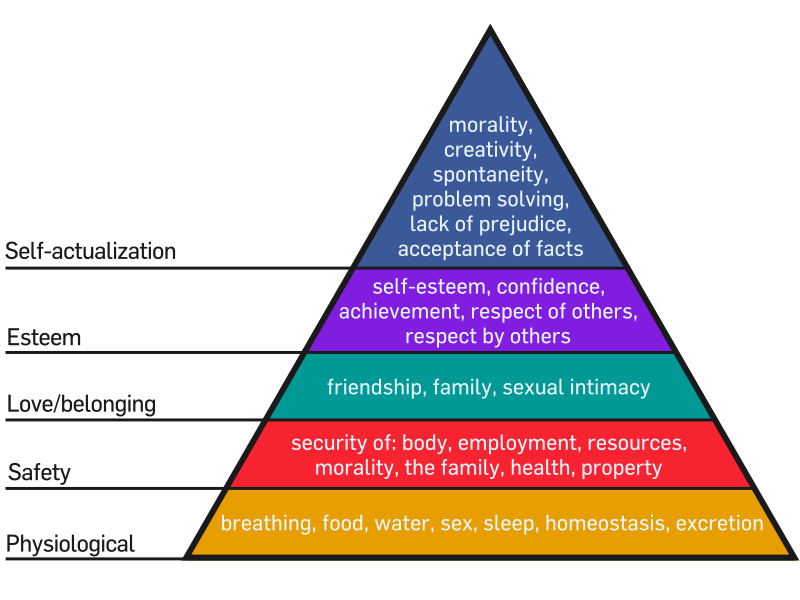
Remember Maslow's hierarchy of needs?


This image was taken from Wikipedia. (http://en.wikipedia.org/wiki/File:Maslow%27s_Hierarchy_of_Needs.svg ) http://creativecommons.org/licenses/by-sa/3.0/deed.en


Acceptance of facts, creativity, and problem solving are needs that will manifest when the individual senses that the lower needs have been met.  While this is intuitive when working with babies, we are tempted to try to work top down with older kids.  "Perform, then you can have..."  

Reflecting on the needs of my newborn reminded me that I need to make a conscience effort to help my older kids feel secure during this time of transition.

Are there some learners in your life who need to have their lower needs met so that they can move on to higher things?


Thursday, January 9, 2014

Ending the holidays with Thanksgiving


Back in November, as we kicked off the holiday season,  kid bloggers and pinners were publishing and passing thanksgiving ideas by the handful.  Today, my kids and I ended our holiday season with our last big event, thank-you note writing.

The long list of relatives and loved ones who generously showered love in the form of great toys, books, and clothes do not expect thank-you notes from my kids.   However, I think it is a helpful holiday tradition.  The things come into their lives so fast, it would be easy for them to lose the connection between the gift and the giver.  I want them to understand that this gift came from someone specific.  I want them to understand that they owe something to that someone who bothered to give something of value to them.  That "something" is gratitude.
 
So, we went back over the list of gifts they received during the Christmas season, and I tried to coach them to tell each giver why they liked the gift.  Some of the notes were enlightening, some will probably bring a much needed laugh.  Some of our family are walking through tough situations.   (By the way, do you have good tips for prompting kids to say something meaningful in this situation?  I would love to try them.)

I think it is good composition practice, and I counted my son's signature as his hand writing practice for today.  Hopefully, it was more though.  Hopefully, it was a lesson in Thanksgiving.

Thanks for reading.  This blog helps me be a better teacher and a better mom by causing me to slow down and consider what I do each day.  Those of you who take the time to read it motivate me to be my very best.

Sunday, September 1, 2013

Five lessons from my Mom, and how she taught them

My mom's birthday card is sitting on the kitchen table, ready to dropped in the mail tomorrow.  That would be a good thing, except her birthday was two weeks ago.  If you said something about it to her, she would just smile and tell you how busy I am, and how well I handle it.  Love always believes the best about someone, and my Mom is one of the most loving people I know.  I drop the ball on things like cards way too often, but I do appreciate my Mom and her influence on my life.

As a tribute to her, would you allow me to share five of the many lessons my Mother taught me, and how she went about teaching them?

A happy life is one spent for others.


My mom started working as a registered nurse at the age of twenty.  Caring for people was not just her job, it was her passion.  I remember her taking extra to to make sure that "her residents" received the best care, although many of them were incapable  of ever expressing appreciation.  Mom always cared for our family with excellence, cooking, cleaning, listening to spelling words long into the evening.  Even today, you will find her volunteering with some of the neediest children in her area.

Read


When my mom was finally still for a few moments, there was always a book or a magazine in her hand.   Biographies have always been her favorite reading material.  She stayed updated on current world affairs and politics.  She always subscribed to professional journals and read them cover to cover.

I was well into my twenties before I realized what a rare example she had set for me as her daughter.  I will always be grateful for the quiet lesson in the importance of reading much, and of reading material of substance.

Work hard


This lesson became clear to me one day when I was about fourteen.  Mom took my sister and I with her to work so that we could volunteer at the facility where she was a nurse.  At the end of the day, she found us fast asleep in the corner.  At home, I took another nap while she fixed dinner, cleaned the kitchen and prepared for another day.  I realized just how hard she worked on a daily basis.  Yet, she never complained and even made it seem  like it was her joy to wash that last sink full of dishes.

I, her child, am valued and loved.


When I was little, my mom told me often of how happy she was that I had come into her life.  She took ten years off from her career to give my sister and I the best possible start in life.  As an adult, I know what sacrifices she and my dad must have made, but at the time she made it seem like nothing but a privilege to spend her time with us.  When she went back to work part time, I knew that it was not just so she could get out of the house.  It was part of her effort to give us the best of everything.

Trust in God


When I was a little girl, I usually woke up to the sound of my mother praying .  Often, she was praying for me.  Children have the rare opportunity to hear their parents' responses in unguarded moments.  Whether responding to a crazy driver or a head strong pre-schooler or a dramatic teenager, my mother's response was to plea God's mercy.  Sometimes, these days,  I hear myself quoting her,  "Lord, have mercy, I don't know what to do with this child."


My Mother taught me many lessons, some of which I will probably only recognize in  the coming years. But for today, I am grateful for the gift God gave me in My Mother.

Tuesday, July 23, 2013

Library Treasures: A Home for Bird


A Home for Bird by Philip C. Stead is the inspiring story of a frog who dedicates himself to helping a lost bird find his way home.   My pre-schooler was attracted to the colorful pictures.  The engaging narrative interested us again and again through out the week.   I hope that my kids will dedicate them selves to helping others, particularly the voiceless, in the way that Frog was dedicated to Bird.   

What values have you found in your literature this week?

Tuesday, June 11, 2013

Training that sticks


My kids are taking swimming lessons this week.  They seem to be having fun.  The teenagers running the local program are enthusiastic and competent.  I have just one complaint.  One little girl has screamed at the top of her lungs for forty-five minutes, two days in a row.  I do not fault the teachers.  I do fault her mother.  Why would you EVER let your child scream in horror in the arms of  stranger for all that time?  Do you really think she is going to learn to be a great swimmer because you insisted on her completing this task to her absolute objection now?

As a side note, if you you are thinking of swimming lessons, I would highly recommend that you personally take the time to help your child feel comfortable holding on to the side of the pool, in a depth over their head, and happily dunk themselves under water on command before you take them to class.  This did involve some bribing in our case, but now both children love to go under water.  We also invested in some goggles.  

I was, and continue to be, frustrated by the mom who sits insistently by while her daughter mourns the expectations.  Then I realized that I was her.   After we arrived home and ate lunch, we commenced our morning "responsibilities" which we had missed due to the swimming lessons.  I found myself rushing my children, insisting that they finish putting away the dishes and laundry now.  They began to object, and I steeled my resolve.  Then, I realized: I am no better than the mom at the pool.  My goal for my kids was a good one, but my method of obtaining it was not.  Is there a reasons they must hurry?  Why can't putting the dishes away be fun? So, when my son asked where the bowls go (as if he doesn't know!), I responded with, "Under your pillow."  He laughed.  "With the plates?"  More laughter, "With the bowls?"  And it was done.  

Having fun took longer. If I wanted the work done quickly, should I not just do it myself?  If my objective is to help my children learn to see responsibility as a joy, I should do what I can to make chore time a happy time.

 I am looking for suggestions.  How do you make chore time fun for yourself or for your kids?


Tuesday, April 16, 2013

How to potty train: Regression


 I know more about toilet training regression than I like to admit.  If you are in the middle of it, I am really sorry.   Here are some things that have worked for me and my kids. Nothing works every time, but eventually something will work whether it is one of these ideas or another.


Talking to a doctor


I knew there had to be a physical problem when my child was sitting on the toilet, and obviously holding it.  The child now loves the doctor, because, "The doctor helps me get better."  There is never a wrong time to talk to a trusted doctor.  Toilet training regression can have multiple physical causes.  Some of those causes require prescription medicine, so talking to the doctor is necessary.  AskDrSears is a medical web-site that I have used, but nothing substitutes for a discussion with a live doctor.  

Identifying an emotional cause


A new sibling, a sibling going to the hospital, and several moves have caused regressions in our household.  In this case, I just tried to do the best I could to reassure my child. Usually, as the change was adjusted to, the regression naturally reversed, but not always.  


Charge ahead, or take a break?  A middle ground


 Some people say that if you let them go back to diapers and start again, they will train faster the second time.  It did not work that way for us.  However, there are times when neither I nor the child can handle charging ahead.

A strategy which I found helpful was to partially revert to cloth diapers.  If the child has success, they get to choose between diapers and underwear.  If they have an accident, they wear diapers.  

I think this works well for a list of reasons.  First, disposable diapers keep the child dry, so they might have a hard time knowing when they have gone.  Cloth diapers let them feel what just happened.  Also, cloth diapers are less comfortable than underwear, so both my kids were pretty motivated to wear underwear.  

 My child  sometimes chose diapers, and I realized that for a perfectionist temperament, the stress of needing to use the toilet was counter productive. Without the stress of a mess on carpet in a rented home, my responses to accidents were more appropriate.   Sometimes the diaper wearing child would make it to the toilet and "earn" under wear.  This strategy let the child feel in control.  I think that was helpful in getting past some of the emotional struggle of regression. For us, it was the right amount of motivation, without the undue stress.

When our move caused a total regression, and I had left cloth diapers behind, I went to Green Mountain and bought six Indian pre-folds, a snappy, and two plastic covers.  That is what you will need if you are starting just when you hope to finish.  If you've never done cloth, ask for the information sheet, it's an excellent resource.

What other tactics would you add to a mom's bag of tricks for over coming toilet training regression? 

                       When Should You Start Potty Training?

Linked to: 

Raising Imperfection

Wednesday, April 3, 2013

How to potty train: Before you actually start


As I mentioned in my previous post, there is not a a hard and fast right time to begin potty training.  Most of us end up trying some where between one and half and three.  When my son showed every sign of being ready around age one, I was totally lost on what to do.  In this post and a few following, I will out-line what I did the second time around, and would recommend.

 Here are some steps I would want take after my baby started walking to get ready for the eventual potty training.  These are recommendations of an ordinary mom, not a medical professional.

Introduce some kind of potty chair.


Healthy toilet use is largely about being relaxed.  Ideally. your child should  feel really comfortable just hanging out on the potty.  There are chairs that you dump into the toilet and seats that make the toilet comfortable.  If you're using the big potty directly, you'll also need a stool that makes sitting up there comfortable and safe.   Put the chair in the bathroom and let your child sit on it while you sing or read books.  You might do it on a schedule or at random.  Just make it fun.

Develop a system for clean up.


Conventional potty training involves many, many, accidents.  It is extremely important that the parent not be too concerned about the accidents.  I find that the easier clean up is, the more relaxed I can be about the accident.  You will need a system of dealing with dirty laundry.  This might simply be a bucket with a lid in the bathroom.  Wipes or clothes used for diapers will still be needed.  You will also need a set of rags (or paper towels or old diapers) dedicated to sopping up.  You will  need a disinfectant .   Clorox Anywhere is my favorite, and is cheaper in the store than on Amazon.

Cloth diapers.


This is negotiable, but I think it really helps.  For one thing, the child needs to know he is doing something in order to respond to it.  Secondly, cloth diapers make a nice in-between option later on.

You do not want the cloth diapers that keep the child dry.  Cotton pre-folds are perfect, and the covers you use with them make great over the under wear covers later.  Gerber has some all in ones that they call training pants, but they're hard to find.

When our move caused a total regression, and I had left cloth diapers behind, I went to Green Mountain and bought six Indian pre-folds, a snappy, and two plastic covers.  That is what you will need if you are starting just when you hope to finish.  If you've never done cloth, ask for the information sheet, it's an excellent resource.

Let the child see some examples.


Easy going souls probably already have their children in the bathroom with them, but for some of us it is the last true retreat.  However,  the child needs to know that people go in toilets if they are ever going to want to do it themselves.  In particular, little boys will probably want to know that it is something that men do.  Observing others is one of the main motivators that causes children to actually begin using the toilet.

Rejoice any time they go with a diaper off.


It can be frustrating to have the mess to deal with, but going with a diaper off is something that you will desperately want to encourage later.  Start responding now with a happy " <insert family term here> ! " .

I would not expect these steps to result in full-time toilet use.  If it does, a huge congratulations to you!  Rather, these steps might help a child  become aware and interested in the process of using the toilet, and help the caregiver be ready when the child is ready.

What else helps a child feel ready to use the toilet?


Tuesday, March 26, 2013

When Should You Start Potty Training?


As any mother of three or more knows, the most knowledgeable moms are those with only two children.  Thus, having pretty well wrapped up potty training with my second, I'd like to share some thoughts on the subject before a third comes along and wrecks my theories!  Please note, these are not scientifically backed assertions, just the observations of a mom who keeps her ears open.

When should you start potty training?


My observation is that the answer to this question is largely cultural.  American pediatricians recommend waiting until the child indicates that he's ready.  You can take a look at the official list of readiness indicators from the American Association of Pediatrics. Some moms say you shouldn't bother at all.  The child will eventually train himself, albeit maybe not until age five! Here's a link to an article by a mom who gave up potty training.  In contrast, my friend in China  received some strong negative feed back from the locals because her daughter was inexcusably old to still be in diapers.  Her daughter was eight months old!  If you are thinking of taking the early route, you may also  want to read this western doctor's opinions, and be sure you're doing it "the way the locals do."

In my opinion the real answer to the question of when is: whenever the primary caregiver says so.   If your child in is in daycare, it's likely that the caregiver has potty trained many children, and you would do well to ask and follow her advice.  Not only will you benefit from her years of wisdom, but your child will have a consistent set of expectations during the day  and in the evening.

Things for the primary caregiver to consider


Potty training is a physical and emotional process.


Muscle tone is an important factor.  A child who is naturally strong will be able to control his body functions faster than one who is more slender.   In addition, some children have special issues that make potty training more difficult.

Toilet use is connected to independence, and the child may react to toilet training depending on how the child feels about independence.  The caregiver may also react based on her feelings about independence, or the act of cleaning up after another.  I  find it somewhat degrading to have to clean up after someone who could have done it for themselves.  It's a personal hang up, but it did effect our toilet training experience.

The younger you start, the longer it will take.


One of my friends did potty train her son, beginning within a week or so of birth.  It took nearly a year before he was consistently using the toilet.  My friend's mom potty trained her child in less than three days, but she waited until after her third birthday.

The younger you start, the sooner you'll be done.


If you glance at the above stories you'll see that starting earlier did result in the child being out of diapers sooner.

The younger you start, the shorter the bathroom intervals you need.


In general, younger children have weaker muscles than older children, so they will need to go more often.  My observation of my children, and friends children is that every twenty minutes is the norm until between eighteen months and passed two-years-old.  This may be why many American moms seem to feel this is the age for potty training.  Running for a toilet every twenty minutes all the time can be quite a chore!

Going on command is different than going as needed.


Although you can apparently train a child to go on command very early, I haven't observed many children who go as needed before three and a half.  If you potty train the child early, you'll also have to train all adults involved in care to think of his or her toilet needs.

Major changes like new siblings and moves will slow down the process.


Most articles and books will actually tell you not to start potty training until you have a period of six months or so free of these kinds of changes.   This is a problem for families like  mine.  By the time we are free of these changes for that long, my oldest might be ten years old!   You can potty train through new babies and through moves.  My son had to deal with a new sister and a move.  My daughter has had to deal with a move across the world, and weeks of other travel.  The changes make it harder, but it can be done.

Going against your community is difficult.


Cultures that advocate early toilet training tend to be more comfortable with children peeing out doors.  Cultures that advocate waiting until the child is ready tend to only accept children peeing in a proper toilet.  If you decide to train your child early, your back up caregivers may not be comfortable following through on your chosen methods.

 On the other hand, if you train later, you may find that people refuse to care for your child at all, as they are not willing to change diapers for older children.  My friend in China ran into this issue with caregivers for her daughter before one-year-old.  In the United States, programs for pre-schoolers around age three may require toilet training.

Let me state again, that the decision of when to potty train resides with the primary caregiver.  There is not a universal right answer for this issue.  I hope that the above thoughts help you make a healthy decision for you and your child.

Saturday, February 16, 2013

Holiday Cookies


We love making sugar cookies for any holiday, or in between holidays.  I use a recipe from the Mennonite Community Cookbook, edited by Mary Emma Showalter.   Few ingredients, no chilling, and perfect texture ever time make this one more treasure from my Mennonite friends.  

My kids love to do the measuring and mixing.  I place the flour and the measuring cup on an old (see it doesn't look good!) cookie sheet to conserve any spillage while my daughter spoons the flour into the measuring cup, Then we work together to level it with a knife, and count out the number of cups needed.  Perfect toddler math lesson and motor skill practice!


The reason I love this recipe is that as soon as the dough is mixed, it's ready to roll.  I clean a section of the table and use the spilled flour from the cookie sheet to flour it and the rolling pin.


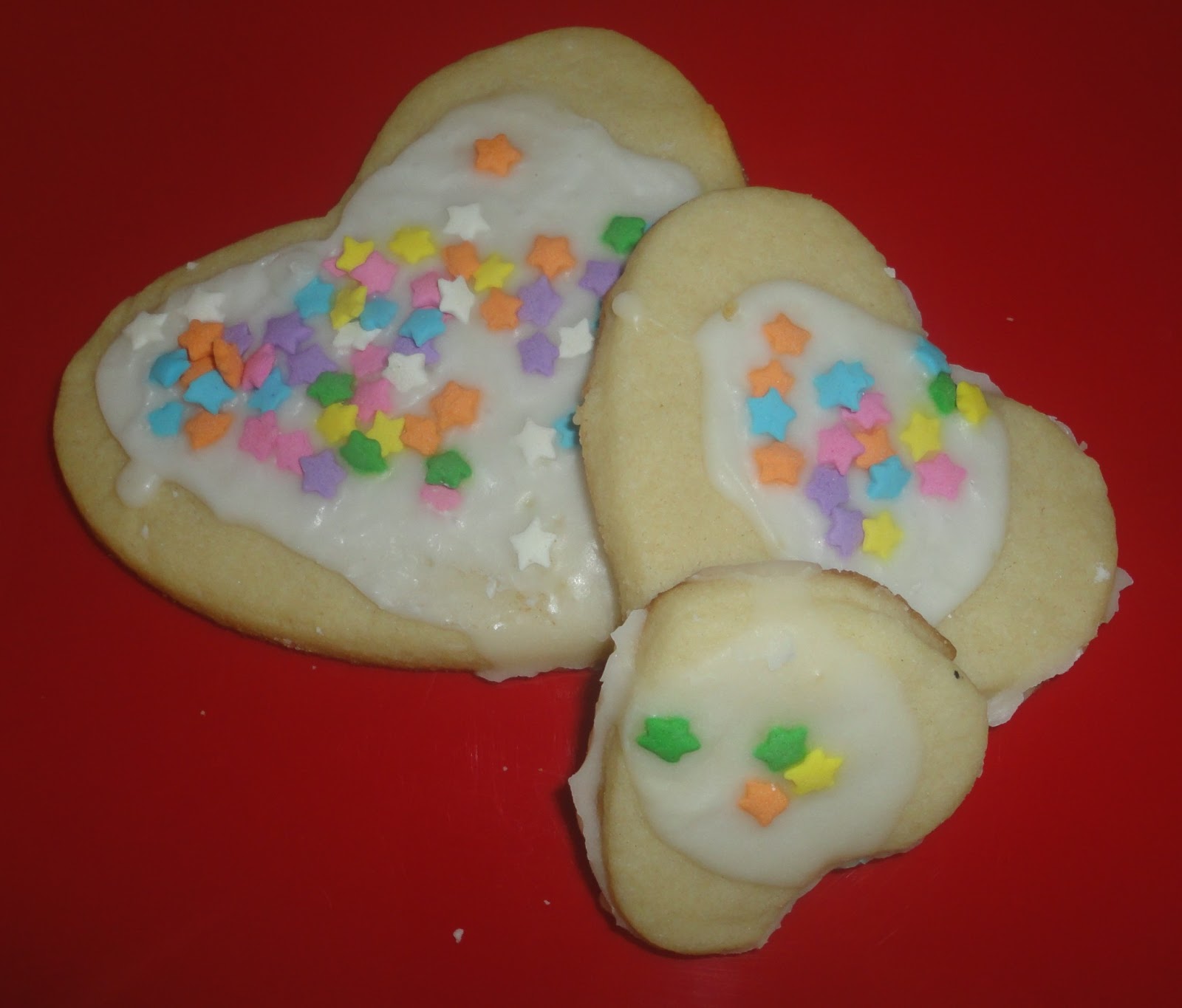
This week we used different sized hearts.  She really wanted to use them all every time, so I explained that the best strategy was to work biggest to smallest.


After the cookies were baked and cooled I mixed a little milk with powdered sugar and added some sprinkles.  (Hint: Mix in just a little milk at a time, and your frosting won't be runny like mine.)


  This recipe was submitted by Mrs. Simon Gingerich.


Ingredients
1 1/2 cups butter
1 1/2 cups sugar
2 eggs
4 cups flour

I like to add 1 teaspoon of salt and 1 teaspoon of vanilla with the wet ingredients to give a little flavor.  


Pre-heat oven to 375 degrees F.  (190 C). Mix the wet ingredients well, then add the flour little by little. Roll out to about 1/8 inch (0.5 cm) thickness and cut with cookie cutters.  Bake until done, about 10 minutes.

Baking with kids is a great way for them to learn.  It's also a great way to stress myself out.  I always allow at least four times the time it would take me to accomplish the task by myself, and don't expect to multi-task.  I keep the ingredients on the counter, and give my kids exactly what I want them to have at that moment.  I expect them to entirely need to change clothes when we're done, and I banish them from the kitchen while I finish baking and clean up.  So far, they're always eager to join in when it's time to bake.


You might also like:
Add a little Biology to your Baking