Monday, July 14, 2014

Get Started with the Alphabet!


This post is part of my at Home Pre-School Boot Camp.  For more information about the series, click here.

Assuming that you are working with the English alphabet, there are fifty-two characters that your child needs to know.  Twenty-six letters with upper and lower cases.  There really is no need to know exactly which ones she does and does not know, unless she knows them all.  The goal of this assessment is just to find three or so to target.  Once she has mastered those, look for a few more.

Quick side note.  Some of my friends who use the British system teach sounds ahead of letter names.  I did not choose this route, but if you want to use it,  just substitute the sound for the name in this exercise. Then you go back to names later.


Get Started!

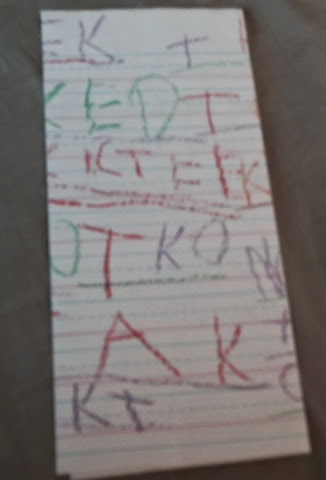
Pull out your alphabet set.  Show one of the letters of your child's name to her.  Ask, "What letter is this?"  If she tells you, hand her the letter. If she can not tell you, tell her the name of the letter and put it aside.  Pick another letter from her name and repeat the process until you have three letters that she does not know. If you finish her name, continue with other letters.

Once you have three she did not know, choose one and show it to her again.  Wait quietly for at least fifteen seconds.  If she says it, give it to her with a word of praise.  If she does not say it, return it to your pile and say nothing.  Repeat with the other two.

Make a note of which letters you are going to target. Offer to read her a book of her choice or spend some time playing together.


 The post, Getting Started with the Alphabet, by Christy McGuire originally appeared on WisdomKnowledgeJoy@blogspot.com.

At Home Pre-School Boot Camp: Week 3 Summary

Welcome to Week 3 of At Home Pre-school Boot Camp!  If you missed the beginning of the series, you may want to start from Week 1.  

Things to do just once this week


Make that formal group activity a priority.  It can be challenging, especially if you have multiple kids in tow, but it is important to your child's long term success!


After painting, this week's new art activity is a breeze.  Click here to learn about construction paper art. 

Pull your magnetic letters or alphabet book! Click here for a simple activity to get you started.

 Review options

 If your child is able to write his name, revisit the simple writing from week one, but on a different day.  If you have time, give painting another go.


Daily habits


Keep up the reading and play times you have already established!  Those two habits are crucial to the success of everything else.  

Enriching your home environment


Do you play music through out the day?  Music is good for your child mentally and emotionally.  Classical, jazz, folk, and your personal favorites should all have a place in your day.  Develop some play lists, buy an album of new music, or find a couple of go to stations on Pandora.  Plan to turn on the music while you do an art project or chores with your kids.

Looking ahead


Next week, it is time to cook!  Choose a recipe, and buy the ingredients. If you need a place to start, try my kid friendly recipe board on Pinterest.  If cooking with kids scares you, choose a recipe labeled "Mix and Measure" or "Simple Sensory".  I will have a post on the "Why and How of Cooking" next week.


Friends to Follow


Becky at This Reading Mama is a true professional.  She is also a mom who writes curriculum for her own kids and shares it.  My kids both love her various reading packs.  You will probably gravitate toward her awesome activities, but be sure to read her posts on language and reading development. I have relied heavily on her insight when working with my own children!

While you are exploring This Reading Mom, you will probably find  Anna, The Measured Mom.  Her reading packets are also popular at our house and have provided hours of appropriate leveled reading practice.  You will also find lots of great hints on working with mixed age levels on her site. Valuable advice for anyone multiple kids!


This post contains Amazon affiliate links.  Click here for more information.   Thanks for your support!  The post, At Home Pre-School Boot Camp: Week 3 Summary, by Christy McGuire originally appeared on WisdomKnowledgeJoy@blogspot.com.

Construction Paper Art


This post is part of my at Home Pre-School Boot Camp.  For more information about the series, click here.

Construction paper, glue, and maybe scissors.  Pre-school art can be that simple, and this project can be adjusted to match the fine motor level of each child in your home.  

Early Motor Skill Development


When my children were just starting to develop their fine motor skills I approached this project two ways.  One way was to just let them tear the paper, then glue it down.  The motions of tearing and gluing strengthen the fine motor muscles, and you might be surprised how much effort can go into creating a piece in this way.

Sometimes, it is more satisfying to actually make a picture though, especially if the card or picture is for someone else.  I would ask my child what he wanted to put in the picture, and quickly cut it out.  He would then glue it on the card.  Again, this strengthens muscles and improves coordination in those little hands.  Working together we made some fun things and wonderful memories.


Scissor Practice

Using scissors is an important skill in its own right, but it also strengthens the muscles needed for holding a pencil well.   Get a good pair of kids scissors that you would not mind using yourself.  Show your child how to hold them, then help him use them to cut the paper.  He may just want to cut, or you can let him glue the pieces together to make a special creation.

Writing Practice

Once he is comfortable holding a pencil, you can ask your child to draw or trace patterns on the paper, then cut them, and re-glue.  This allows your child to gain confidence in manipulating the pencil, without the added pressure of trying to form letters.  

Projects!


There are so many great projects to do with construction paper!  We used it a year ago to make some finger puppets, and before that we made some self portraits.  In fact, T-Rex just saw these pictures and asked to do it again!


 We love Discovering Great Artists by MaryAnn F.Kohl and Kim Solga, and their lesson on Henry Matisse calls for a technique similar to this.  If you keep the colored paper, scissors, and glue together in an easy to find box, you will be ready to go with any of these lessons or just to enjoy the afternoon together making some art!


This post contains Amazon affiliate links.  Click here for more information.   Thanks for your support!  The post, Construction Paper Art, by Christy McGuire originally appeared on WisdomKnowledgeJoy@blogspot.com.

Saturday, July 12, 2014

Amazing Whistling Eggs!


  Deviled eggs are great for potlucks, sliced eggs add protein to summer salads, and all that egg boiling provides an opportunity for some interesting observation.

Boiling eggs are noisy!  Shrill whistling sounds accompanied the cooking process in this photo, and you can see why.


  Those little bubbles were escaping from all the eggs.  The Pony Artist was very interested in the little bubbles.  I told her that I thought they were made of air that was expanding inside of the egg.  She was fascinated to learn that there can be air inside of an egg.  I explained that the shell allows air to pass through it, providing oxygen to the chick inside.  At this point, she became very concerned that we were preparing to eat baby chicks.  I assured her that this was not the case.  Eggs containing chicks do not make their way to grocery stores, and are not generally eaten --at least not in our culture.

While we were on the subject of cooking eggs, I explained that it is important to turn up the temperature on the water slowly when cooking eggs.  Causing the expansion to happen to quickly will break the shell.  I also demonstrated that phenomena this week, but did not photograph the ugly results.

 Finding all three states of matter, , gas, and a solid composing a single object is fascinating to me.

Has anything fascinating appeared in your kitchen recently?


The purpose of this Science Along the Way series is to help me, my kids, and my readers appreciate the wonder of the natural world in our every day experience. If you have an experience that you would like to share, please e-mail me at WisdomKnowledgeJoy@gmail.com. 

The Post "Amazing Whistling Eggs!" first appeared on WisdomKnowledgeJoy@blogspot.com.

Saturday, July 5, 2014

Bottle Rocket Experiments

This activity addresses Next Generation Science Standard
5-PS1-4.Conduct an investigation to determine whether the mixing of two or more substances results in new substances.

When I first started with the Recycle! Create! group, I thought that I was challenging myself to develop activities for my children.  However, it has become very obvious that my older children, T-Rex in particular, are beyond that.  They still need guidance and supervision , but they can do their own projects.

So, if you will indulge some Mommy bragging, I would like to show you their bottle project.

T-Rex wanted to use vinegar and baking soda to launch a bottle.  Pony artist wanted to try it too, so they each carefully measured baking soda and vinegar and recorded the amounts in their journals.


prompted them to mix their ingredients at the last minute and we set up our rockets out doors.


We were not thrilled with the results, so we went in and journaled.  It was time for me to take care of Little Diddle, so they did not get to try again that day. 


 Our basic problem was too much baking soda.  I pointed this out, so the next time they had time to work, T-Rex adjusted the amount.  It was perfect!  It reacted quickly and explosively!  All over me, so no pictures.

The next step will be to figure out a mechanism that allows us to get things set up before the explosion.  We have done some work on it, but no success yet.  I will let you know if we figure it out. If you have an idea, we would be interested to hear it.


Do you have your own ways to use bottles?  Join the Link up!


Friday, July 4, 2014

Camouflage in the House


  Can you see what the Pony Artist found?  The little grasshopper blended quite nicely with the goo.  (Old weatherstripping, I think.  There is always one more project, eh?)


When we disturbed him, he was much more visible against the dark wood.  We eventually convinced our little friend to head outside.

 I always thought camouflage was kind of happenstance, but it seems like the grasshopper knew where he needed to be.  If you know how he knew where to be, we would love to learn more. Please tell us!


The purpose of this series is to help me, my kids, and my readers appreciate the wonder of the natural world in our every day experience. If you have an experience that you would like to share, please e-mail me at WisdomKnowledgeJoy@gmail.com.


Tuesday, July 1, 2014

Passing Down a Way of Life with a Simple Garden Journal--and a The Ultimate Nature Study Linkup!

This activity can be used to address the following Next Generation Science Standards 
K-ESS2-1.Use and share observations of local weather conditions to describe patterns over time
K-ESS2-2.Construct an argument supported by evidence for how plants and animals (including humans) can change the environment to meet their needs.

We had one next door neighbor when I was a girl.  Miss Evie was already somewhere in her seventies when we moved into our new home in the late nineteen eighties.  I was exactly seven.  She lived in the same home where she had grown up, where she had lived as a young married woman, and cared for her husband and parents as each had left this world.  

I used to get her mail on warm summer afternoons in hopes of being invited into the immaculate 1950's era kitchen she cooled by a cunning system of opening windows in the morning then shutting both windows and curtains as the day wore on.  I would sit bare foot on the red company chair by the door, and we would discuss the health of our cats and the progress of our gardens.  She would tell me stories handed down from her relatives who had lived through the Civil War or of her own experience living through the Great Depression.  Our whole family loved her dearly, and I think that in some ways we filled a spot her own children and grandchildren would have held, if she had had any.  That might be one reason she gave it to my dad.  She might have given it to him because of his love for growing things.

It was an old fashioned notebook filled with careful notes in a squarish antique hand.  Miss Evie's father had kept careful notes about his little farm for years.  He recorded where, when, and what grew , and how he tended it.  For my dad, who was now tending plants in the same location, it was treasury of helpful information.

This spring was our in our new home.  I wanted my children to keep journals based on our yard and garden, but was struggling to get them started.  Then I realized, they were not the ones who needed to keep a journal.  I was.   I grabbed a notebook and started filling it with notes .  I measured some plants, counted blossoms, and wrote down some temperatures and rainfalls.  Soon my kids were eager to join me, and they ask if we can do our. "Garden journal".

Our little journal is not all that amazing, or even organized.  It is a start though.  I hope my kids are learning the importance of paying attention to the natural world around them.   Not just as a fun summer project, but as a way of life. The systematic careful attention to how and why things grow that Miss Evie's dad practiced is a tradition I want to pass on to them.


Today, I am joining some other bloggers in hosting a Nature Observation blog hop.
Take a moment to look at the great ideas from my co-hosts!  As you look through the posts, I hope you can find a few methods that allow you to bring the richness of natural observation into your experience, and that of your children. 

July 2 update.  Now that I've had a chance to look at everyone's post, I'm even a bit more excited.  Check these out!


Suzy Homeschooler This is a must read, especially for those of you who are facing extreme weather like we experienced in the Middle East and in Arizona.

Homeschool Antics A great tutorial on how to turn backyard observation into a full fledged  nature study.

Houseful of Chaos  A lovely reflective approach, with a couple of interesting twists.


Study-at-Home Mama If studying nature is a little overwhelming to you, this post has the practical ideas you need.

Inspiring NH Kids Is showing us a great demonstration of a weather phenomenon we often, face.  I will be coming back to this!


My Blessings Homeschool Ideas for creek exploration.  My kids are going to enjoy this one!

Kid World Citizen A great list of fun hands on ideas.


There's also a multi- topic link-up.   I am looking forward to reading ideas you have for observing nature!