It was one of those hard fought, "we can barely make it out the door on time" mornings. As we headed up the road (at constant velocity) my five-year-old said, "Mommy, what if the road were moving and we were holding still?"

Wisdom Knowledge Joy
Showing posts with label Science along the way. Show all posts
Showing posts with label Science along the way. Show all posts
Sunday, October 23, 2016


Friday, August 1, 2014
Shadows: How a baby can learn science along the way

Little Diddle (5 months) went with me to take some excess garden produce to the neighbor. On the way home, she noticed something interesting. She leaned forward and made little cooing sounds to alert me to her discovery.
Can you believe it?! The sun's rays were bouncing off the road. However, none of the rays could travel straight through our bodies. Only the rays that refracted (bent) around our bodies could make it to the piece of road we blocked from the sun. The result was a dark spot shaped like us that traveled just in front of us.
In her Saturday Science post this week, Dayna Abraham of Lemon Lime Adventures stated that science learning can start at birth.
I love that idea. One way to do facilitate that learning is by simple time outdoors. By celebrating these simple discoveries with our kids, we encourage their science learning.
What has a little one next to you seen recently?
The purpose of this Science Along the Way series is to remind me, my children, and my readers to celebrate the wonder of the natural world around us. Scientific statements on this blog are made with the intention accuracy. If you see an error, kindly leave a correction in the comments.
The post, Shadows: How a Baby Can Learn Science first appeared on WisdomKnowledgeJoy@blogspot.com.
Saturday, July 26, 2014
The Other Way to Make Balloons Float

"Hey Mom, Look!" Have I mentioned that is my favorite phrase? Well, at least when it means "Look what I noticed," not "Watch me break my leg."
These balloons were filled with plain old air, not helium. However, they were floating up, and then falling down again in a kind of circular pattern. It was really quite mesmerizing. When I asked my children why this was happening, they quickly identified that the air particles from the vent were hitting the balloon and making it move. This is great, because understanding that air is made of molecules that can have this impact is one way to prove that gas can have mass, and therefore really is matter. Most people today readily believe this, but it is not actually all that intuitive, and has been highly debated in other times.
T-Rex was able to give me a clear explanation of the major forces. Gravity pulls the balloons down, the air molecules push them up. When the force of the air molecules is greater than gravity, the balloon moves up. When the force of the air molecules is smaller than the force of gravity, the balloons move down.
In terms of energy, there is a transfer of kinetic (moving) energy from the air molecules to the balloon. As the balloon moves up it trades its kinetic energy for potential energy due to gravity. When it falls toward earth again it trades the potential energy for kinetic energy once again.
Next time you notice a moving object, stop and ask. Why is it moving? It can be a pretty interesting question.
The purpose of this Science Along the Way series is to help me, my children, and my readers stop and notice the amazing physical world in which we live every day. Thanks for reading!
This post "The Other Way to Make Balloons Float, by Christy McGuire, first appeared on WisdomKnowledgeJoy.
Friday, July 18, 2014
Pivot Points and Spinning Spoons

Children are hard wired to do science. T-Rex (5) and Pony Artist (4) demonstrated this the other day at breakfast. I do not know who started it, but they took turns spinning this spoon.

They discovered that the spoon spins best when just one point touches the table.
They tried placing the spoon with both ends touching the table. It did not spin well, and tended to flip over.
It was a perfect experiment with just one variable: which way the spoon was facing. I pointed out to them what they had done, but they were more excited about the spinning spoon itself.

You see, they had just figured out an important physical principle. Solid objects naturaly spin around a single point. They might not put it into words just yet, but they definitely learned it.
What have you and yours learned from play this week?
Saturday, July 12, 2014
Amazing Whistling Eggs!
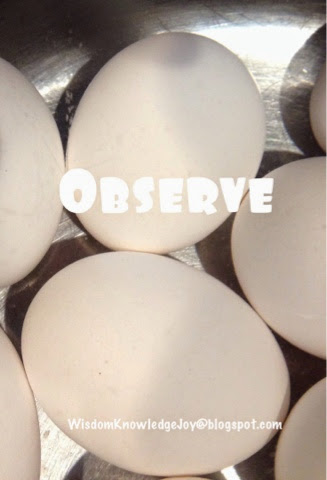
Boiling eggs are noisy! Shrill whistling sounds accompanied the cooking process in this photo, and you can see why.

Those little bubbles were escaping from all the eggs. The Pony Artist was very interested in the little bubbles. I told her that I thought they were made of air that was expanding inside of the egg. She was fascinated to learn that there can be air inside of an egg. I explained that the shell allows air to pass through it, providing oxygen to the chick inside. At this point, she became very concerned that we were preparing to eat baby chicks. I assured her that this was not the case. Eggs containing chicks do not make their way to grocery stores, and are not generally eaten --at least not in our culture.
While we were on the subject of cooking eggs, I explained that it is important to turn up the temperature on the water slowly when cooking eggs. Causing the expansion to happen to quickly will break the shell. I also demonstrated that phenomena this week, but did not photograph the ugly results.
While we were on the subject of cooking eggs, I explained that it is important to turn up the temperature on the water slowly when cooking eggs. Causing the expansion to happen to quickly will break the shell. I also demonstrated that phenomena this week, but did not photograph the ugly results.
Finding all three states of matter, , gas, and a solid composing a single object is fascinating to me.
Has anything fascinating appeared in your kitchen recently?
The purpose of this Science Along the Way series is to help me, my kids, and my readers appreciate the wonder of the natural world in our every day experience. If you have an experience that you would like to share, please e-mail me at WisdomKnowledgeJoy@gmail.com.
The Post "Amazing Whistling Eggs!" first appeared on WisdomKnowledgeJoy@blogspot.com.
Has anything fascinating appeared in your kitchen recently?
The purpose of this Science Along the Way series is to help me, my kids, and my readers appreciate the wonder of the natural world in our every day experience. If you have an experience that you would like to share, please e-mail me at WisdomKnowledgeJoy@gmail.com.
The Post "Amazing Whistling Eggs!" first appeared on WisdomKnowledgeJoy@blogspot.com.
Friday, July 4, 2014
Camouflage in the House

Can you see what the Pony Artist found? The little grasshopper blended quite nicely with the goo. (Old weatherstripping, I think. There is always one more project, eh?)

When we disturbed him, he was much more visible against the dark wood. We eventually convinced our little friend to head outside.
I always thought camouflage was kind of happenstance, but it seems like the grasshopper knew where he needed to be. If you know how he knew where to be, we would love to learn more. Please tell us!
The purpose of this series is to help me, my kids, and my readers appreciate the wonder of the natural world in our every day experience. If you have an experience that you would like to share, please e-mail me at WisdomKnowledgeJoy@gmail.com.
Saturday, June 28, 2014
Coquinas: Beautiful Diggers

Sunset over the Gulf of Mexico last week was beautiful. The beach was re-nourished this year, so it is not quite as pretty, but it is still alive!
We had a great time just watching these little guys bury themselves in the sand. Daddy is the local, so he explained what we were seeing.

Coquinas are a type of clam that live right on the edge of ocean where the tide comes and goes. The water uncovers them as it recedes, and they bury themselves until the next wave brings them their next meal, and in turn retreats.
The shells are beautiful, and even as an adult I could watch them burrow all day. It is amazing that these little creatures move so fast! I found a picture that shows how they use a muscular foot to bury themselves. Click here and scroll down to the "foot" heading to see it.
The Gulf was in the news a few years ago because of an environmental disaster. A question on many people's mind is how to teach others to respect the lives of creatures like the Coquina. I think that observing first hand is a key part of the answer.
What has fascinated your family this summer?
Tuesday, June 10, 2014
Swinging Baby Catch and Inertia

I asked T -Rex to tell me what force pulls the swing back down. He knew it is gravity. Then I asked, "Why does the swing keep going at the bottom of its path, and start moving up?" He was puzzled.
I told him that it is because the swing is already moving. If something is moving, it will keep moving until something stops it. He smiled.
I asked him again just now if he knew why the swing keeps going. He answered , "Because it was already moving." Yay!
Newton's First Force Law says that a thing will keep moving at the same speed and in the same direction, unless something stops it. This tendency to keep doing the same is called inertia.
Centrifugal (center fleeing) motion is sometimes credited to a force with the same name. You are not likely to see such a force, and if you did, it would have another name. The movement away from center is due to inertia.
The vast majority of circular systems depend on a centripetal (center seeking) force, in this case the rope, and inertia.
Here is a challenge for you. Find some circular motion examples and figure out what the centripetal (center seeking ) force is.
I would Love to hear what you find!
The goal of this Science Along the Way series to help me, my kids, and my readers take notice of the wonder around us every day in the physical world. If you would like to share a phenomenon you have noticed, e-mail me at WisdomKnowledgeJoy@gmail.com.
The post, Swinging Baby Catch and Inertia, first appeared on WisdomKnowledgeJoy@blogspot. com.
Saturday, June 7, 2014
Thunder and Lightning must be Friends

We have been enjoying alot of weather here in the south east US this week. We were just ready to leave the library on Thursday when the wind picked up and the lights went out. We spent an hour getting to know some new friends better in the dark while we waited for things to calm down.
Tonight, things were rumbling again. As I was tucking him in, T-Rex asked, "So Mom, what is thunder anyway?" I told him that thunder is energy. The energy moves through the air, making waves and causing them to rumble. Our ears receive that chaos as the sound "thunder."
Energy is the most basic thing in the natural world. So, I push myself to explain things to my children in terms of energy. (This is actually debatable, but enough people with Phd.'s agree with me that I am going to go ahead and just make it a statement.) If you want to go a little deeper, you might think about the fact that lightening happens because electrons build up in the clouds during storms. When the charge gets strong enough, the electrons jump to the ground. This jump releases a huge amount of energy. Some of it is light, or "lightning". Some of the energy physically moves out through the air. That is thunder.
A little later, Pony Artist was out of bed, (That happens on stormy nights, right?) As she headed back to her room, she turned to me and said, "I think thunder and lightening must be friends."
All children are natural scientists. What have yours been observing lately?
Friday, May 30, 2014
Seeing heat: Science along the way

The other night we were cooking out when my son noticed that the air above the grill "looked like water." You may have seen the same phenomenon on the road on a hot day. Why can we see heat waves?
Why can we see anything?
When electromagnetic (EM for short) rays bounce into objects, some are absorbed and others are reflected, depending on their wavelength. (You could say also say frequency, its inverse.) Rays with wave lengths between 380 nanometers and 750 nanometers in length are received by our eyes and interpreted as colors.
If an eye receives all the possible frequencies equally from an object, the brain interprets the color as white. If the eye receives no electromagnetic waves between 380 nanometers and 750 nanometers from an object, the brain perceives the object as black. So, on the above picture, we can see EM rays of around 530 nm , reflected from the green tree.
The EM waves we usually see come to us through air that is moving pretty slow, at least compared to EM waves which travel at 3 x 10^8 m/s in a vacuum where nothing is in their way. As the air molecules gain heat energy, they start to move faster. In fact, an air molecule may be moving so fast that it carries a little piece of the light wave with it as it moves up. Think of an elevator for light. Our eyes perceive that light wave at a slightly higher spot than where it originated.
The next piece of the light wave may not catch an air molecule "elevator" and put eye perceives it at the original place. These back to back changes in perception are what make the "watery effect".
So why does water look that way?
Molecules of (liquid) water move much more slowly than air molecules. Why does it produce the same effect? Hint: The light changes as well.
Take the weekend to ponder. I will keep an eye on the comments, so feel free to ask for more hints. I will post the solution on Monday.
This post by Christy McGuire first appeared on WisdomKnowledgeJoy.
Other Posts you might enjoy:
Saturday, May 24, 2014
What is fog?Science Along the Way
This is the first time we have experienced multiple seasons in a temperate climate in quite a while. It has been fun to watch my children react and enjoy.

This is our front yard Monday morning. My son wanted to know what that stuff was. After I informed him that it was fog, he said, "Can I go see what it is like?" After some observation, he described it as "damp" and "pretty cool".
Both descriptions are accurate. Fog is a collection of water droplets hanging in the air.
Where did the water come from?
In this case, the water had been there for a couple of days. Warm air is able to incorporate more water droplets in its mix than cool air. As long as the sun was heating the earth, the water remained as vapor in the atmosphere. After dark, the molecules in the air began to loose energy, until it was "pretty cool." When the water molecules loose energy, they may decrease in temperature. They may also change into liquid droplets.
Why do the droplets float?
Archimedes"s principle: if the mass of the fluid displaced by the object is greater than the mass of the object, it floats. (Remember the Greek guy yelling Eureka?) The force of the fluid on the droplets is called the buoyant force. So, as long as a water droplet displaces a mass of air greater than it's own mass, it floats.
When a group of those droplets hang in the air, we call it a cloud. A cloud near the ground is called fog. When the droplets join together, they bond tightly displacing less air for the same amount of mass. The force of gravity pulls them to earth, and we call it rain.
The purpose of this series is to help me, my children, and my readers appreciate the natural world. If you have found science along your way, I would love for you to share it here.
E-mail me at WisdomKnowledgeJoy@gmail.com for more information.
Other posts you might enjoy: Cold Blooded Animals on a Cool Day
Friday, May 16, 2014
Cold Blooded Animals on a Cool Day

"Mom, I found a worm and a slug, and they are moving really slow."
We are having what the locals call "blueberry winter". By "winter", we mean that you will want a jacket in the morning. However, it is cool enough to slow down cold blooded animals, and I think that was the problem for the little mollusk (slug) and annelid (earth worm) that T-Rex found.
Other classes of animals such as mammals and birds have mechanisms to control temperature. Their metabolism speeds and their pores close. Our cold blooded little friends loose their energy to the cool air, and that is why they were moving kind of slow.
Here's a nice article on Annelids and
Molusks I found while doubling checking my facts:
http://www.tulane.edu/~bfleury/diversity/labguide/mollannel.html
The purpose of this series is to help me, my children, and my readers appreciate the natural world. If you have found science along your way, I would love for you to share it here.
E-mail me at WisdomKnowledgeJoy@gmail.com.
Friday, May 9, 2014
Science Along the Way: Why Does Tapping a Jar Lid Help it Open? And an Invitation for Guest Posts

Why does tapping a jar lid make it open more easily?
This question comes from Summer at Outside Kid and her kids. It would take some more involved experimenting than I can do to be sure, but here's my best guess. Thanks to my husband for helping me with this answer.
First, let's think about what forces are working against you as you unscrew the lid. Friction is the force between two surfaces that opposes motion between surfaces. The magnitude of the friction is dependent both on the types of materials involved, and the surface area in contact between the surfaces.
The other important force is the one created by the low pressure inside the jar. The manufacturer intentionally removes air from the jar so that more particles push on the lid from the top than from the bottom. The lid is pinned to the jar by the weight of the air molecules pushing down on it.
Now, back to the knife tap. The knife tap bends the lid just a little bit. This decreases the surface area in contact with the jar, and may let in some air. The decreased surface area leads to a decrease in the magnitude of the friction. Any air that comes into the jar, helps push the lid up. For more on why air would flow into the jar, read about playing with a straw here.
Thank you, Summer, for this great question! I am always amazed at how complicated every day physical events really are. Summer's family has been busy building the coolest tree house ever! You might want to click over and take a peek.
The goal of this Science Along the Way Series is to help me, my kids, and my readers appreciate the wonder of the physical world that surrounds us every day. If you find an phenomena worth pondering along your way, I would love to feature it as part of this series. Guest posts and questions are welcome. E-mail me at WisdomKnowledgeJoy@gmail.com.
Friday, April 25, 2014
Science Along the Way: Chemical Reactions at Easter
Can you recognize this picture?


Yes! This is a tablet from our Easter egg dying kit, dissolving in vinegar earlier this week.
While we were enjoying the show, I realized that this was a fantastic example of a chemical reaction. There was a color change and gas production, both hallmarks of a chemical change.
We could see it, hear it and touch it. Using multiple senses is always a bonus!
Easter was last week. You can consider this my "being a real mom" confession. My kids still got excited!
What piece of nature has excited you and yours this week?
Saturday, April 19, 2014
Sound Waves

One of my goals is to play music during the inbetween times of our day. One day this week, I noticedy my son playing with the sound, using his hand to block it.
Since sound waves are physical waves, meaning they travel from molecule to molecule, they can be blocked by placing a something in front of them. Some of the wave's energy was absorbed by my son's hand instead of continuing through the air. We perceive the decreas in energy as the sound becoming quieter .
When the waves ran into his hand, they bent. We perceive bent waves as a distortion in sound which changes the pitch.
How do you like to play with sound?
Saturday, April 12, 2014
Science Along the Way: Drain Solution
It seems that we find a lot of science in the bath tub--and it has happened again. The mechanism in our drain broke.
"Don't worry," said the Pony Artist, "I have a solution."
This is post has moved. Check out our simple drain solution over at Thriving STEM.
Wednesday, April 2, 2014
Hand Soap Magnification Glass

We were cleaning up after painting (and Mommy was feeling a little frantic) when T-Rex pointed out that the hand soap makes a magnifying glass.
The light rays bend as they move through the soap, spreading out as they move through the soap, and making his fingers appear wider.
Also, did you notice how the curves edge of the soap container makes his finger look crooked?
What have you noticed this week?
Happy Friday!
Friday, March 14, 2014
Science Along the Way: Flower Coloring in Reverse

My parents bought flowers to celebrate our new little one. These particular flowers were chosen by my four-year-old. You may recognize that they are dyed.
In addition to giving a vibrant spring look, dying various types of white flowers is a common demonstration of a plant's circulation system. We were surprised, to see the flowers start to un-dye after a day or so. If you look carefully at the base of the vase, you can see the dye. White streaks began to appear on the flowers.
Of course the question from my children was "Why?" I had to pull out Biology by Raven and Johnson (Wow, my addition is old now!). I learned that with the exception of calcium, particles that the xylem carries up, will travel down through the phloem with the water. For some reason, I had believed that minerals from the ground had a one-way ticket, but that is not the case. In fact, we could see dye oosing from the leaves and stems as well. Apparently, unless the plant's cells grab them and use them, the particles just circulate through the plant with the water.
It's always a good day to see something new!
Find more science posts at

Wednesday, March 5, 2014
Flower Garden Mystery

We moved to our new home in the south east US in early February, and soon after were excited to see these shoots emerging in our front flower bed. This is a brand new climate for our family. I asked my children what these might be, and they were convinced that they must be vegetables.

Over the next couple of weeks we watched the shoots develop. My kids still believed these were vegetables.

Finally, just at the end of the month, the truth emerged. Unfortunately, a harsh rain got to them ahead of my camera.

We had been observing other people's daffodils for several days, and were thrilled to find that we had some of our own!
What signs of spring are appearing in your area?
Sunday, February 23, 2014
Whose hole is that? Habitat study along the way

We were headed home from the play ground, when my four-year-old noticed this hole. "Look, Mommy, a hole!"
My five-year-old immediately declared that this was an animal home. After determining that it was a fairly deep tunnel, we began to discuss what type of animal would live in it. He thought it was probably a muskrat. She thought it was a beaver.
I asked whether the hole was big enough for those animals and whether they would typically want to hang out at the top of a hill. My older child began to doubt his hypothesis. The younger one is sure a beaver wants a tunnel from the river to the top of that hill.
I would guess that if it really is an animal burrow, it would belong to a snake, but I don't know. It is fun to imagine possibilities. Maybe some day one of them will be am expert naturalist who can point out the details needed to solve the mystery.
Subscribe to:
Posts (Atom)