Saturday, February 16, 2013

Holiday Cookies


We love making sugar cookies for any holiday, or in between holidays.  I use a recipe from the Mennonite Community Cookbook, edited by Mary Emma Showalter.   Few ingredients, no chilling, and perfect texture ever time make this one more treasure from my Mennonite friends.  

My kids love to do the measuring and mixing.  I place the flour and the measuring cup on an old (see it doesn't look good!) cookie sheet to conserve any spillage while my daughter spoons the flour into the measuring cup, Then we work together to level it with a knife, and count out the number of cups needed.  Perfect toddler math lesson and motor skill practice!


The reason I love this recipe is that as soon as the dough is mixed, it's ready to roll.  I clean a section of the table and use the spilled flour from the cookie sheet to flour it and the rolling pin.


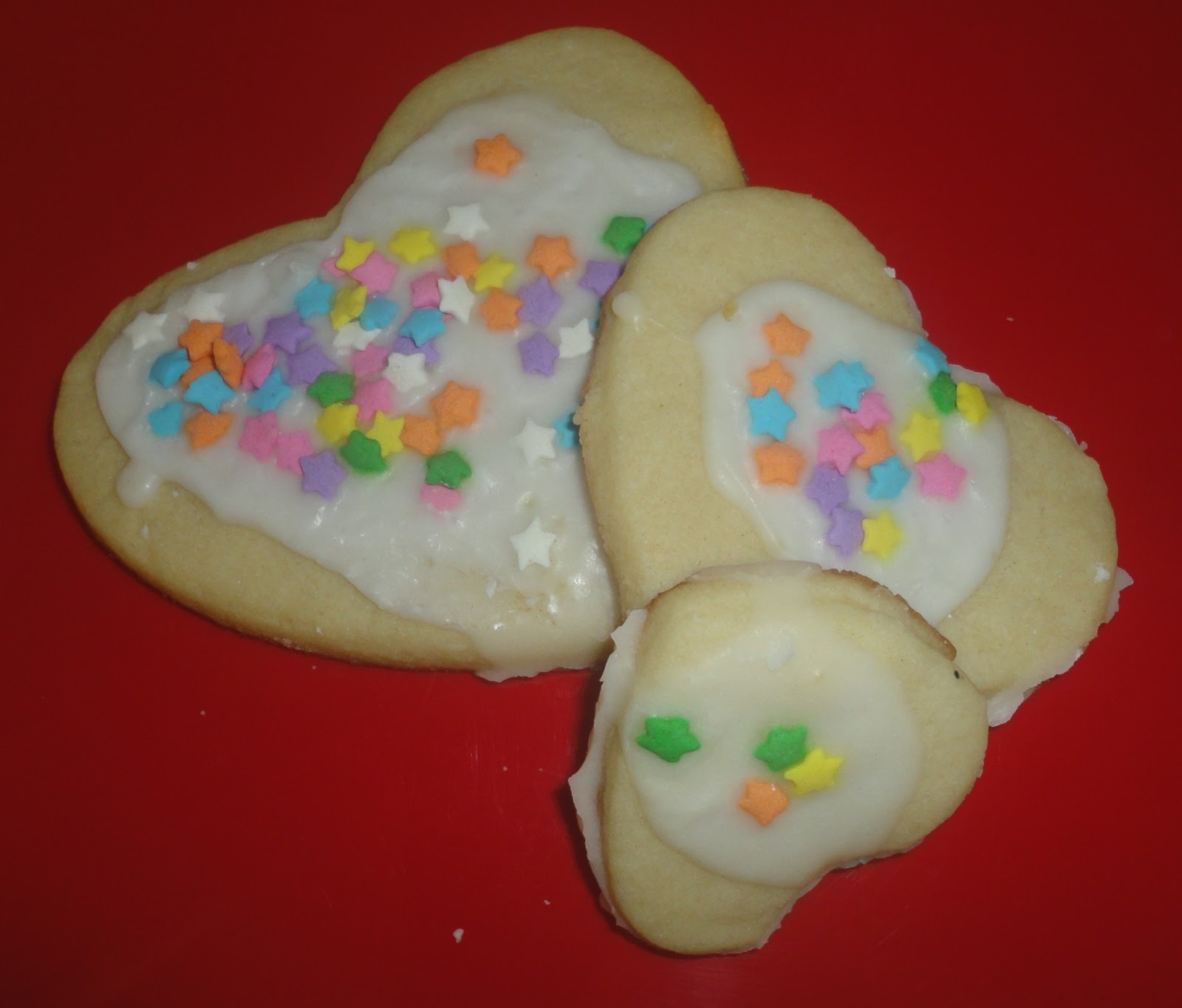
This week we used different sized hearts.  She really wanted to use them all every time, so I explained that the best strategy was to work biggest to smallest.


After the cookies were baked and cooled I mixed a little milk with powdered sugar and added some sprinkles.  (Hint: Mix in just a little milk at a time, and your frosting won't be runny like mine.)


  This recipe was submitted by Mrs. Simon Gingerich.


Ingredients
1 1/2 cups butter
1 1/2 cups sugar
2 eggs
4 cups flour

I like to add 1 teaspoon of salt and 1 teaspoon of vanilla with the wet ingredients to give a little flavor.  


Pre-heat oven to 375 degrees F.  (190 C). Mix the wet ingredients well, then add the flour little by little. Roll out to about 1/8 inch (0.5 cm) thickness and cut with cookie cutters.  Bake until done, about 10 minutes.

Baking with kids is a great way for them to learn.  It's also a great way to stress myself out.  I always allow at least four times the time it would take me to accomplish the task by myself, and don't expect to multi-task.  I keep the ingredients on the counter, and give my kids exactly what I want them to have at that moment.  I expect them to entirely need to change clothes when we're done, and I banish them from the kitchen while I finish baking and clean up.  So far, they're always eager to join in when it's time to bake.


You might also like:
Add a little Biology to your Baking


Thursday, February 14, 2013

Two Books For Black History Month

February is Black History Month.  Here are two books we've enjoyed recently that would be great for a Black History theme.


The Hidden Feast  is a traditional Black American folk tale about barnyard animals.  The morale of the tale is persistence, although it also teaches gratitude.


Head, Body, Legs  comes from Liberia.  Reminiscent of the Biblical parable about the eye needing ear, body parts meet up in an African forest and learn to work together.


Thursday, February 7, 2013

Science for Pre-school Artists

Here's a quick add-on to a painting activity that doubles as a science lesson.  On this particular day we happened to be painting with sparkly paint, which turned out to be a bonus, although I wouldn't say it was necessary.

Read more at Thriving STEM.

Tuesday, January 22, 2013

Friday, January 18, 2013

Pre-school science: Ducky in the Bath

Did you ever wonder what a former physics teacher would say to her daughter about a rubber ducky in the bathtub?  Probably not, but are you wondering now?


This experience relates to the K-4 science standards which state that students should learn to understand position and motion of objects, and fulfills the goal which calls for the teacher focus and support inquiries while interacting with students.  (Reference science standards.)

The other night I was trying to convince my daugheter that her ears should be washed when she pointed and said, "Mom, stop the duck from moving!"  Her rubber ducky, a treasure from a the goody bag at her cousin's birthday, was aimlessly floating forward and backward, forward and backward.  I thought to myself, what lovely example of harmonic motion!

Of coure, stopping the duck from moving while fulfilling the unspoken parameter of keeping it in the water is nearly impossible.  The water is a liquid with millions of particles in motion.  Stopping the duck completely would mean stopping the water.  She likes her bath hot, not icy, and changing the liquid to a solid by cooling it would be the only way to stop the duck in the bath.

So, I said, "Look!"  and thrust my hand into the water near the duck.  The duck moved away from my hand. I repeated it on the other side.  Then she tried it.  This trick produced the illusion of control that any healthy two-year-old craves, and negated the need for the ducky to actually stop.

I explained that the water pushes on the duck, and that's called a force.   I told her that her hand puts a force on the water and then the water puts a force on the duck.  I might have dropped the the word bouyant (the type of force that pushes the duck up.)  I might have said something about the water, her hand, and the her hand all taking up space.  I just couldn't help myself.  There's so much to say about a rubber duck in the bath tub.

But, if I'd like to lecture about such things, I need to get back to the classroom and bigger victims.  My sweet daughter just needed her bath, and some fun with mom.  Then we tried to do as many other things as we could with the ducky in the water.  It floated upside down, it sank.  It floated just below the surface right side up.   It squirted water out and took water in.  Maybe she won't loose the wonder of such moments if I give the credibility.  I hope not.  


Friday, January 11, 2013

Jamaican Time Rhyme


When Johnny was one, he learn to suck he thumb,
Thumb Tilda, thumb Tilda, half past one.

When Johnny was two, he learn to clean he shoe,
Shoes Tilda, shoes Tilda, half past two.

When Johnny was three, he learn to climb mango tree,
Tree Tilda, tree Tilda, half past three.

When Johnny was four, he learn to shut de door,
Door Tilda, door Tilda, half past four.

When Johnny was five, he learn to dig an' dive,
Dive Tilda, dive Tilda, half past five,

When Johnny was six, he learn to pick up sticks,
Sticks Tilda, sticks Tilda, half past six.

When Johnny was seven, he fly up to heaven,
Heaven Tilda, heaven Tilda, half past seven.

When Johnny was eight, he learn to shut de gate,
Gate Tilda, gate Tilda, half past eight.

When Johnny was nine, he learn to feed de swine,
Swine Tilda, swine Tilda, half past nine.

When Johnny was ten, he learn to feed de hen, 
Hen Tilda, hen Tilda half past ten.

Jamaica

This mesmerizing little piece comes from A Caribean Counting Book by Faustin Charles and Robertan Arenson.  We've done it two ways, and enjoyed them both thoroughly.

Simple Counting


When we first came accross this poem, my two-year-old daughter was just learning the basics of counting.  As I read the rhyme, I illustrated it by holding up my fingers, starting with my thumb, and dancing them in the are to the rhythm of the syllables.  She was soon holding up her little fingers, connecting the number names with the concepts they represent through tactile means.

The inability to do math without fingers is sometimes lamented in older elementary children.  However, as a former physics teacher, I'm much more disturbed by high school students who cannnot do math on their fingers.  There's nothing wrong with counting on your fingers until you're proficient enough that it's inefficient anyway.  Well, that's my opinion.

Telling time


My four-year-old son was already fairly comfortable with counting.   I try to make a point of having a an old fashioned clock with hands in the house when I can, and he had become interested in the clock on our wall six months or so before.  I taught him that when the longer hand was on the twelve he could look at the shorter hand to tell "the o'clock".  He'd watch the clock, just waiting for a chance to tell us what time it was with accuarcy.

This rhyme presented the perfect opportunity to add to his time-telling prowess.  I pulled out our trusty Melissa and Doug clock puzzle. We reviewed how to know when it was an "o'clock time, reviewing an establised skill before moving to the new one.  Then I moved the long hand to the six, and announced that this was the half-past position.  I then asked him to place the small hand on the one.  As we progressed through the poem, he eagerly moved the hour hand around the face of the clock.


Rhyming


As I read through the rhyme, I stop before the number allowing my children to fill in the number that rhymes with the preceding rhyme.  "Shoes Tilda, shoes Tilda, half past ____."  They enjoy filling in the "two" that rhymes with shoe, and sharpen the phonological awareness that reading experts say is so important.

The rhyme ends with ten, but the clock does not.  My son agrees with the clock, so we keep going and my children to generate the needed tasks for Johnny that rhyme with eleven and twelve.  

I hope you enjoy as much as we do!


Saturday, January 5, 2013